
Everyone Is “Fibermaxxing” Now. Here’s What the Evidence Says About the Right Amount
Fibermaxxing, the trend of deliberately packing your diet with fiber, is everywhere on social media right now. The idea sounds simple: if some fiber is good, more must be better. The research says something more useful. The benefit is real, it is biggest when you move from low to adequate intake, and how much “more” helps depends on you.
What fibermaxxing actually is
The term describes eating far more fiber than usual, often by stacking beans, seeds, berries, oats and whole grains in the same day. It borrows from “protein-maxxing,” and like most trends it comes in a careful version and an extreme one. The careful version is backed by decades of nutrition research. The extreme version, piling on grams as fast as possible, is not.

What the biggest review found
The strongest single source is a 2019 series of systematic reviews and meta-analyses in The Lancet by Reynolds and colleagues. It pooled data from 185 prospective studies and 58 clinical trials with 4,635 adults.
- When the highest fiber consumers were compared with the lowest, the observational data showed a 15–30% lower risk of all-cause and cardiovascular death, coronary heart disease, stroke, type 2 diabetes and colorectal cancer.
- In the clinical trials, higher fiber intake was linked to lower body weight, lower systolic blood pressure and lower total cholesterol.
- The risk reduction was greatest at 25–29 g of fiber a day, and the dose-response curves suggested that higher intakes could bring further benefit.
- The authors rated the certainty of evidence as moderate for dietary fiber.
One caution matters here. Most of these findings come from observational studies, which show association, not proof of cause. People who eat a lot of fiber also tend to differ in other habits. The trials on weight, blood pressure and cholesterol are what make the case stronger.
Where most Americans actually are
A paper from a 2014 Food & Fiber Summit reports that national consumption surveys indicate only about 5% of the U.S. population meets fiber recommendations. Most people believe they eat enough. For the typical American plate, then, the practical goal is to reach an adequate intake, not to overshoot it.
Disclosure: one author of that paper works for a cereal company, so we use it only for the intake figure, not for any claim about products.
Is more always better? A Stanford trial
A 2021 study in Cell from Stanford randomly assigned healthy adults, 18 per group, to a high-fiber diet or a high-fermented-food diet for 17 weeks and tracked their microbiomes and immune systems.
- The high-fiber diet increased microbiome enzymes that break down plant carbohydrates, while overall microbial diversity stayed stable.
- The study’s primary outcome, a cytokine response score, did not change. But three different immune patterns appeared in the high-fiber group, and they matched each person’s starting microbiome diversity.
- The fermented-food diet steadily increased microbiome diversity and lowered markers of inflammation.
It is a small study, so treat it as a clue, not a rule. The message is that the same extra fiber does not do the same thing in every gut. If you are curious about the fermented-food side, see our look at fermented cabbage and gut health.
How much, level by level
A commonly cited U.S. adequate intake is about 25 g a day for adult women and 38 g for men under 50, which is also close to the 25–29 g range in the Lancet review. Here is one way to think about it.
| Level | Daily goal | What to do |
|---|---|---|
| 1. Find your baseline | Know your number | Track fiber for three ordinary days with any nutrition app. Most people land well under 20 g. |
| 2. Reach adequate | About 25–30 g | Add one fiber-rich food to each meal: beans, lentils, berries, oats, whole grains, vegetables. |
| 3. Diversify | 30 g and up, if it feels good | Vary the sources instead of adding more of one. Add fermented foods. Stop climbing if bloating or discomfort persists. |
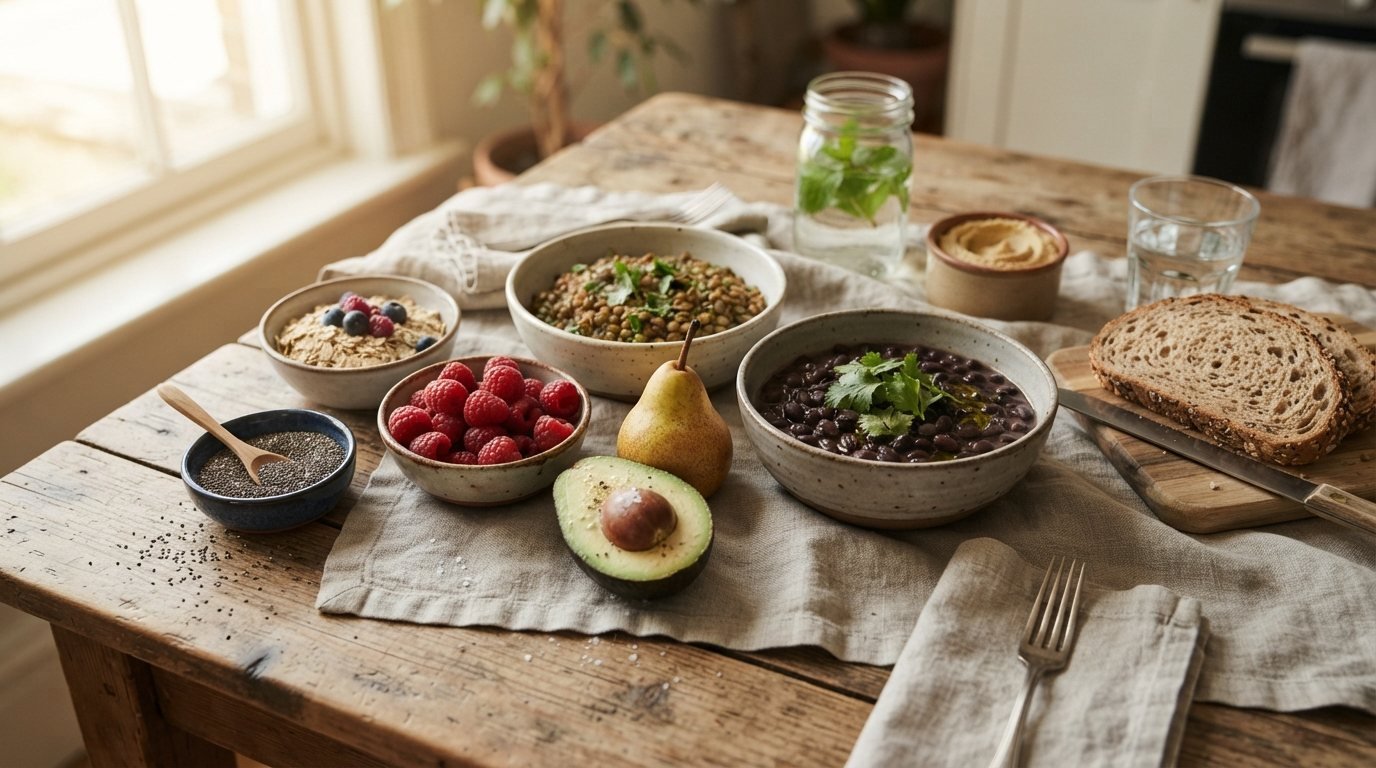
What 30 grams looks like on a plate
These are approximate values based on USDA FoodData Central. Brands and portions vary, so check labels.
| Food | Portion | Fiber (approx.) |
|---|---|---|
| Cooked lentils | 1 cup | about 16 g |
| Cooked black beans | 1 cup | about 15 g |
| Chia seeds | 2 tablespoons | about 10 g |
| Raspberries | 1 cup | about 8 g |
| Pear with skin | 1 medium | about 5–6 g |
| Avocado | ½ medium | about 5 g |
| Rolled oats, dry | ½ cup | about 4 g |

A sample day that gets to roughly 30–35 g: overnight oats with a tablespoon of chia and half a cup of raspberries at breakfast (about 13 g), a bowl of lentil soup with half a cup of cooked lentils at lunch (about 8 g), a pear as a snack (about 5–6 g), and half an avocado with a whole-grain side at dinner (about 8 g).
How to ramp up without regretting it
Suddenly doubling your fiber is the quickest way to end up gassy and bloated. A practical approach, widely used by dietitians, is to add a few grams at a time over a couple of weeks and to drink more water as you go. Let your gut adjust before the next step.
- Start with one swap a day, such as oats instead of a low-fiber cereal or beans on a salad.
- Spread fiber through the day rather than loading one meal.
- Mix soluble and insoluble sources. Oats, beans and psyllium are rich in soluble fiber, as covered in our review of psyllium and cholesterol. Whole grains and vegetables add insoluble fiber.
- Know the gut bacteria angle. Some fibers feed bacteria that make butyrate, a compound we explain in our guide to butyrate, and starches that resist digestion are covered in our piece on resistant starch.
Who should go slower
Fiber is safe for most healthy adults, but a few groups should talk to a clinician before raising intake sharply: people with irritable bowel syndrome, inflammatory bowel disease (especially during a flare), a narrowed bowel or history of obstruction, recent abdominal surgery, or delayed stomach emptying. Fiber can also affect how some medicines are absorbed, so ask a pharmacist about timing if you take daily medication.
If you are looking for a gentle food-first option for regularity, our article on kiwifruit for constipation covers one of the better-studied choices.
Questions people ask
How much fiber should I eat per day?
A commonly cited U.S. adequate intake is about 25 g for adult women and 38 g for men under 50. The 2019 Lancet review found the largest risk reduction at 25–29 g a day. Needs vary with age, calorie intake and health conditions.
Can you eat too much fiber?
Very high intakes, especially if reached quickly, can cause gas, bloating, cramping and constipation if you do not drink enough fluid. Increase gradually and stop climbing if symptoms persist. Some medical conditions call for lower fiber, so ask your clinician.
Do fiber supplements count?
They count toward your total, and some, like psyllium, have trial evidence for cholesterol. But whole foods also deliver vitamins, minerals and other plant compounds, so most guidance prefers food first.
Is fibermaxxing just a trend?
The label is a trend. The advice underneath, eat more beans, whole grains, fruit and vegetables, is one of the most consistent findings in nutrition research.
Keep reading
Verified sources
- Reynolds A, Mann J, Cummings J, Winter N, Mete E, Te Morenga L. Carbohydrate quality and human health: a series of systematic reviews and meta-analyses. Lancet. 2019;393(10170):434–445. PMID 30638909
- Wastyk HC, Fragiadakis GK, Perelman D, et al. Gut-microbiota-targeted diets modulate human immune status. Cell. 2021;184(16):4137–4153. PMID 34256014
- Quagliani D, Felt-Gunderson P. Closing America’s fiber intake gap: communication strategies from a Food and Fiber Summit. Am J Lifestyle Med. 2017;11(1):80–85. PMID 30202317
- USDA FoodData Central, fiber content of common foods. fdc.nal.usda.gov
This article is for education only and is not medical advice. Talk to a qualified clinician before changing your diet if you have a medical condition or take medication.