What almost nobody knows about butyrate is that this single gut compound quietly controls inflammation, mood and metabolism — and one daily fiber makes far more of it
What if a single molecule made by your gut bacteria held the key to your daily energy, brain fog, and body-wide inflammation? Most people search for health in complex supplement stacks. They completely overlook butyrate — a short-chain fatty acid (a small molecule your gut bacteria make from fiber). Butyrate fuels the cells lining your colon. It also acts like a dimmer switch, turning down inflammation across your whole body.
By the end of this guide, you will have a clear, step-by-step approach. It uses prebiotic fiber (fiber that feeds your good gut bacteria) to help your gut make more butyrate.
Why This Matters Today
Our bodies are quietly starving — not for calories, but for fiber. Our ancestors ate far more fiber each day than most modern adults do. That shortfall starves the helpful bacteria in our gut.
When those bacteria go hungry, butyrate production drops. A low butyrate level can weaken the gut barrier — the lining that keeps harmful substances inside the gut where they belong. When that barrier weakens, toxins may leak into the bloodstream. Research links this leakage to body-wide inflammation, insulin resistance (when the body struggles to use blood sugar properly), and mood disorders.
A randomized, double-blind, placebo-controlled trial (the strongest kind of study, where neither participants nor researchers knew who got the real treatment) enrolled 50 people with metabolic syndrome and fatty liver disease. It found that a butyrate-based supplement formula was linked to significant improvements in fatty liver scores compared with a placebo [PMID: 39125336]. Not getting enough fiber is linked to metabolic and inflammatory problems that can quietly drive chronic disease. The cells lining your colon — called colonocytes — get a large share of their energy directly from butyrate, as one review notes [PMID: 29438462]. Without enough butyrate, those cells may not work properly.
The Science Behind It
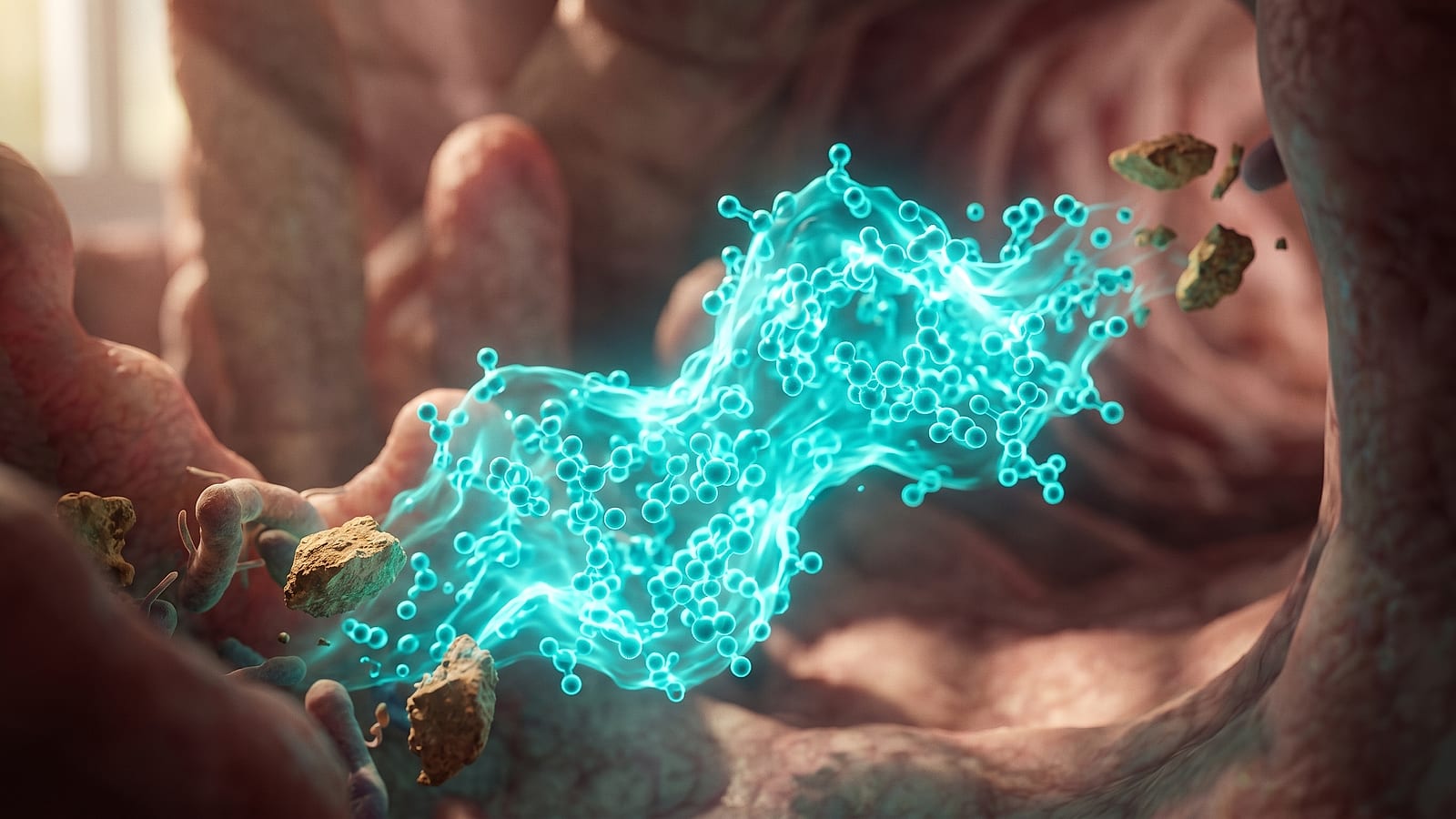
Butyrate is not just a waste product from digestion. It is a signaling molecule — a chemical messenger that tells cells what to do. The colonocytes lining your large intestine depend on it to survive. When your gut bacteria ferment (break down) prebiotic fiber, they produce butyrate. That butyrate then binds to specific cell receptors and triggers a chain of helpful reactions.
In animal and cell studies, butyrate has been shown to support gut lining repair. Research found that it activates a specific repair pathway — called the macrophage/WNT/ERK signaling pathway — that increases mucin production [PMID: 35194640]. Mucin is the gel-like protective layer coating your gut wall. It helps keep harmful bacteria from breaking through. When that layer is damaged, harmful substances called lipopolysaccharides can enter the bloodstream and trigger low-grade inflammation throughout the body.
Butyrate’s ability to calm inflammation goes beyond the gut. One review explains that butyrate works as an HDAC inhibitor (a molecule that changes how genes are switched on or off) and signals through receptors on cell surfaces. This helps balance the immune system and strengthens the tight junctions — the seals between gut lining cells — that keep the barrier intact [PMID: 29438462]. By shaping the gut’s immune environment, butyrate may help reduce the body-wide inflammatory signals that show up as joint stiffness, brain fog, and fatigue. Butyrate is linked to calming inflammation across the whole body by influencing how immune cells behave.

The gut-brain connection may also be shaped by butyrate. A 2024 systematic review and meta-analysis (a study that pools results from many trials) found that probiotic and prebiotic treatments that raised butyrate levels were linked to better depression scores. However, the link between butyrate levels alone and depression did not reach statistical significance on its own [PMID: 39063542]. A separate review also notes that growing evidence points to butyrate’s role in the gut-brain axis — the two-way communication system between your gut and your brain [PMID: 29438462].
A randomized, placebo-controlled trial in people with IBD (inflammatory bowel disease) found that oral microencapsulated butyrate — a supplement form designed to survive stomach acid and reach the colon — added to standard treatment was linked to significant improvements in disease activity and gut inflammation markers in Crohn’s disease patients. It was also linked to shifts in the gut microbiome (the community of bacteria living in the gut) [PMID: 41354580].
In short, a steady supply of butyrate is linked to better gut health, healthier metabolism, and possibly better mood. So how do we support more of it?
The Complete Protocol

Rebuilding your butyrate production takes a gradual, steady approach. Adding large amounts of prebiotic fiber too quickly can upset your digestion. A tiered approach gently supports your gut bacteria and lets their populations grow over time.
Start with the food source
- Cooked and cooled white potatoes: Cooking and then cooling potatoes creates Type 3 resistant starch. This type of starch passes through the small intestine undigested and feeds butyrate-producing bacteria in the colon.
- Suggested amount: About 150 grams (roughly one medium potato) per day.
- Preparation: Boil or bake the potatoes, then refrigerate them for at least 24 hours. Eat them cold or gently reheated at a low temperature to help preserve the resistant starch.
Move to the concentrated natural form
- Raw unmodified potato starch: A concentrated source of resistant starch.
- Suggested amount: Start with 1 teaspoon (about 4 grams) per day. Slowly increase to 1 tablespoon (about 12 grams) over about 10 days. Going slowly gives your gut time to adjust.
- Preparation: Whisk into cold water or a room-temperature smoothie. Take it at the same time each day.
Optional: the supplement form
- Microencapsulated butyrate (for example, calcium butyrate): A stable supplement form designed to survive stomach acid and reach the colon. The randomized trial [PMID: 39125336] used a formula containing 500 mg of calcium butyrate per tablet, taken once daily for 3 months. It found improvements in liver and metabolic measures in people with fatty liver disease and metabolic syndrome.
- Timing: Taking supplements with a meal is a common general recommendation. Follow the guidance on the specific product and check with your healthcare provider.
When NOT to do this
Do not start a high-prebiotic protocol if you have active SIBO (Small Intestinal Bacterial Overgrowth — too many bacteria in the small intestine) or during an active ulcerative colitis flare. Fermenting these fibers in the small intestine can make severe bloating, pain, and bacterial overgrowth worse. Always talk to your doctor before making major changes to your diet or supplements.
Consistency matters most. If you experience mild gas, reduce the raw starch dose rather than stopping completely.
Frequently Asked Questions
Can I combine this protocol with a low-FODMAP diet?
Yes, but with care. FODMAPs are certain types of carbohydrates that can trigger digestive symptoms in sensitive people. Partially hydrolyzed guar gum and raw potato starch are actually low-FODMAP at these doses, unlike inulin or chicory root. If you are in the elimination phase of a low-FODMAP diet, start with just half a teaspoon of raw potato starch. Watch your digestive response closely for 48 hours before increasing the amount.
What if I miss a day of raw potato starch — should I double the dose?
No. If you miss a day, simply go back to your normal dose the next morning. Doubling the dose overwhelms your gut bacteria. That leads to sudden fermentation, painful bloating, and gas. Steady, consistent doses work far better than large, irregular ones.
How does oral tributyrin compare to raw potato starch for raising butyrate?
Raw potato starch feeds your own butyrate-producing bacteria. Over time, this builds a sustainable, natural ecosystem in your gut. Tributyrin supplements deliver ready-made butyrate directly to the colon. Tributyrin can be useful for fast gut lining repair, but it is a short-term fix. For lasting gut health, you still need prebiotic starch to keep feeding your resident bacteria.
Is the supplement form necessary if I eat cooled potatoes daily?
No, it is not strictly necessary. If you eat cooled white potatoes or other resistant starches every day, your gut bacteria will produce plenty of butyrate on their own. The supplement form is best for people with serious gut damage, frequent travel, or difficulty eating enough starchy foods.
Verified Sources
- Butyrate: A Double-Edged Sword for Health? — Advances in nutrition (Bethesda, Md.), 2018 (PMID 29438462)
- Effect of Supplementation of a Butyrate-Based Formula in Individuals with Liver Steatosis and Metabolic Syndrome: A Randomized Double-Blind Placebo-Controlled Clinical Trial. — Nutrients, 2024 (PMID 39125336)
- Impact of oral butyrate on clinical and biochemical parameters in IBD: A randomized placebo-controlled study targeting gut microbiota. — Digestive and liver disease : official journal of the Italian Society of Gastroenterology and the Italian Association for the Study of the Liver, 2026 (PMID 41354580)
- Butyrate- and Beta-Hydroxybutyrate-Mediated Effects of Interventions with Pro- and Prebiotics, Fasting, and Caloric Restrictions on Depression: A Systematic Review and Meta-Analysis. — Life (Basel, Switzerland), 2024 (PMID 39063542)
- Gut microbiota-derived butyrate regulates gut mucus barrier repair by activating the macrophage/WNT/ERK signaling pathway. — Clinical science (London, England : 1979), 2022 (PMID 35194640)
Bloated, tired, foggy, or fighting cravings?
Get The Gut Reset free — a science-backed guide to go from “off” to clear, light and energized. Drop your email and we’ll send it straight to your inbox.
No spam. Unsubscribe anytime. Educational content, not medical advice.