Kiwifruit for Constipation: 2 Green Kiwis a Day Added About 1.5 Bowel Movements a Week
If you are going to try kiwifruit for constipation, three questions decide whether it is worth the effort: how many, for how long, and whether it is safe for you. In the largest trial so far, 184 people ate two green kiwifruit a day for four weeks, and the ones with constipation had about 1.5 more complete bowel movements per week than at baseline. This guide turns that trial, and a second smaller one, into a plan you can follow and measure.

How many kiwifruit, and for how long
The number comes straight from the trials, so it is worth being exact about what each one tested.
| Trial | Who | What they ate | Length | Main result |
|---|---|---|---|---|
| Gearry et al., 2023 (international, multicenter) | 63 healthy adults, 60 with functional constipation, 61 with IBS-C | 2 green kiwifruit a day, or psyllium 7.5 g a day, in a crossover | 4 weeks per treatment, 4-week washout | Kiwifruit: +1.53 CSBM/week (functional constipation), +1.73 (IBS-C); better gut-comfort scores; no significant adverse events |
| Eady et al., 2019 | 32 mildly constipated adults | 3 gold kiwifruit a day, or Metamucil 14.75 g (5 g fiber) a day, in a crossover | 4 weeks per treatment, 4-week washout | 6.3 CSBM/week on kiwifruit vs 3.3 at baseline and 4.5 on Metamucil; softer stools, less straining |
A “complete spontaneous bowel movement” is one that happens without a laxative and leaves you feeling empty. It is the measure both trials used, and it is a better target than “how often I go,” because a rushed, incomplete trip does not count.
Four weeks is the length both trials ran for each treatment. If you are trying kiwifruit on your own, it is reasonable to give it about that long before deciding it does or does not suit you.
Green or gold
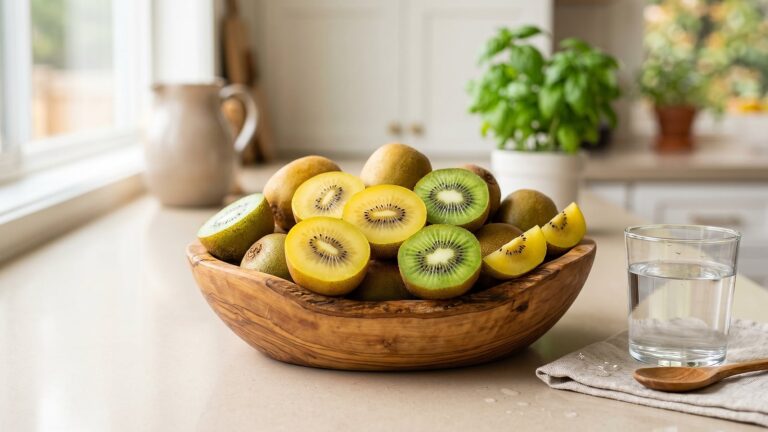
The larger 2023 trial used green kiwifruit, two a day. The 2019 trial used a gold variety (a cultivar called Zesy002), three a day. They are different fruits at different doses, so the results are not interchangeable. A 2022 scoping review of 12 clinical trials with 661 participants found good evidence that green kiwifruit may reduce abdominal discomfort and pain, and some evidence for indigestion. It examined gold and green, but its abstract does not declare a winner.
The practical reading: if you can find ripe green kiwifruit, start with two a day, since that is the dose from the biggest study. If you prefer gold, the smaller trial used three, so you would need to eat more of it to match what was tested.
How to eat them: ripeness, skin, water
The trial abstracts do not spell out preparation details, so the points below are common-sense kitchen advice rather than trial findings. Treat them as defaults you can adjust.
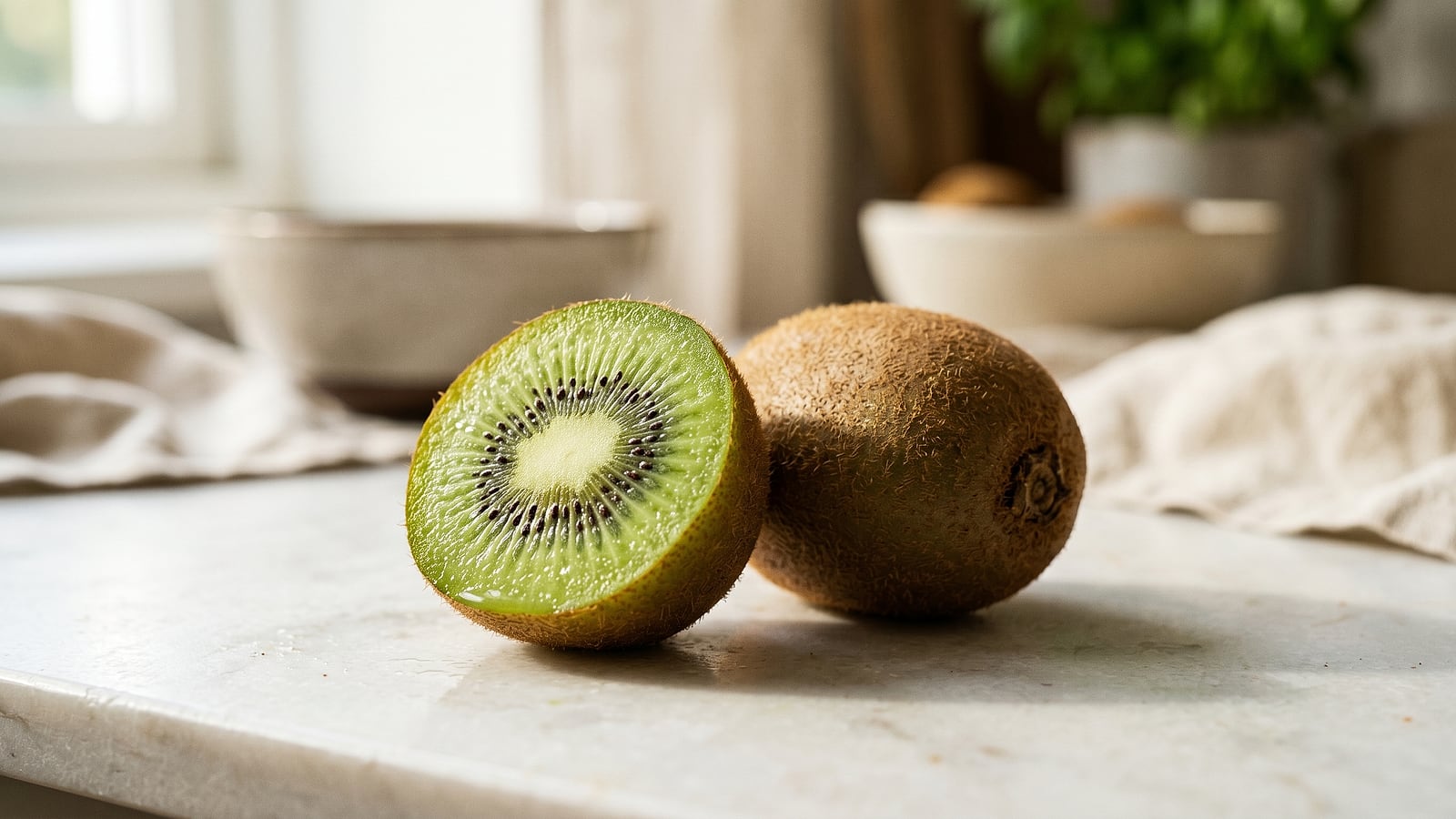
- Ripeness: a kiwifruit that gives slightly under a gentle squeeze is ripe. Hard ones are sour and harder to eat in quantity, which matters when the plan is two or three a day. Leave them on the counter for a few days to soften.
- Skin: the skin of green kiwifruit is edible and adds fiber, but it is fuzzy and many people dislike it. Rinse well and rub off the fuzz if you want to try it. Eating the flesh alone is fine, and the skin was not what the trials tested.
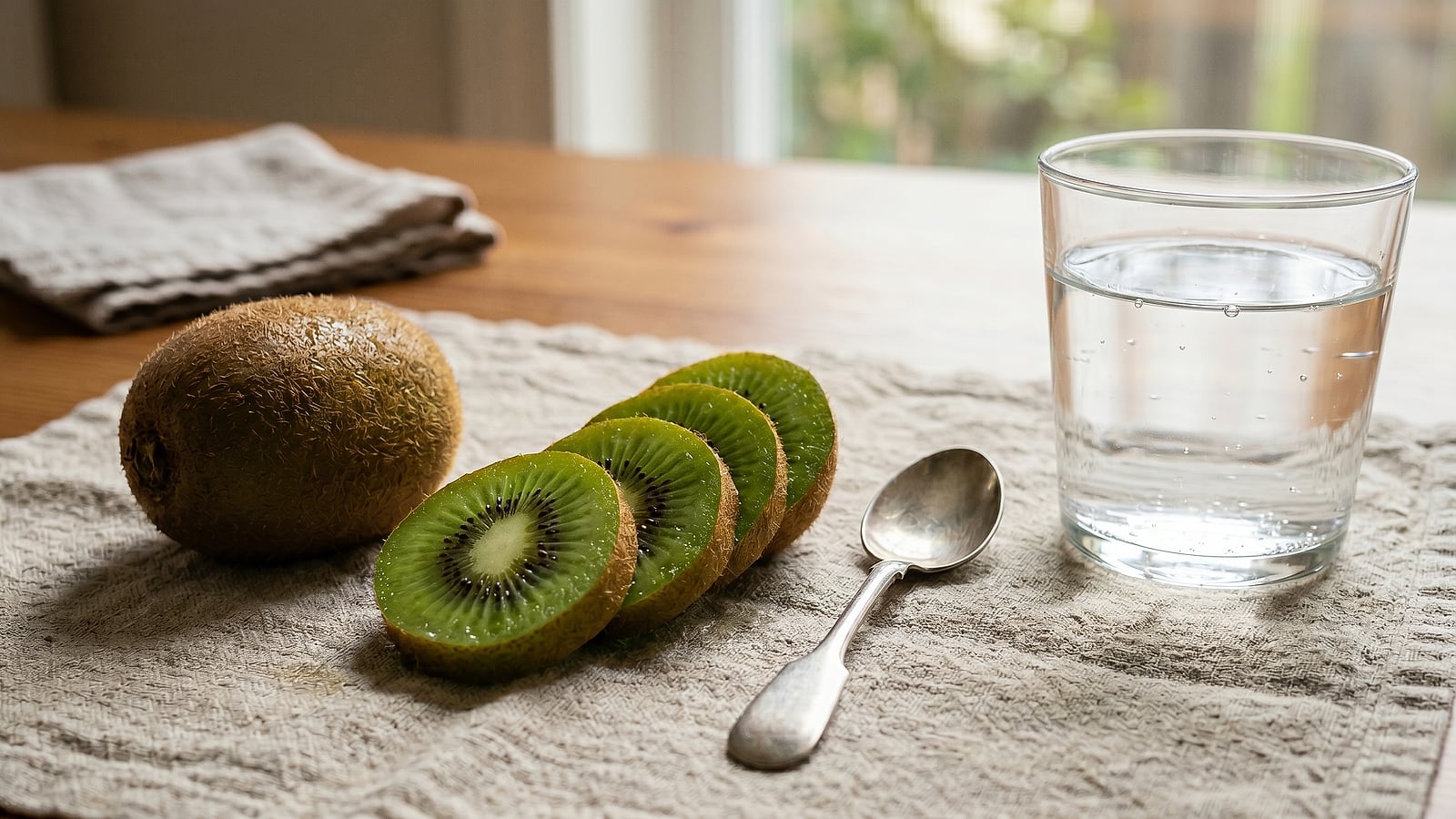
- Water: fiber works better with fluid. Have a glass of water with your kiwifruit and keep drinking normally through the day.
- Timing: the abstracts do not say what time of day participants ate them. Pick a slot you can repeat, such as breakfast or an afternoon snack, because consistency is easier to track.
- Ramping up: if your usual fiber intake is low, extra gas for a few days is common. Starting with one a day for the first week and moving to two is a gentle way in. This is a practical suggestion, not a tested protocol.
What to expect, and how to track it
The honest expectation is a shift, not a transformation. In the 2023 trial the average gain over baseline was around 1.5 extra complete bowel movements a week for people with constipation. In the 2019 trial, people went from about 3 to about 6 a week. Averages hide individual spread, so some people will do better and some will notice little.
A simple way to find out whether it works for you is to count. Use a notes app or a paper calendar and mark each bowel movement that felt complete and happened without a laxative.
| Step | What to do | What it tells you |
|---|---|---|
| Baseline | Count complete bowel movements for 1 to 2 weeks before changing anything | Your own starting number, comparable to the trials’ baseline |
| Trial period | Add the kiwifruit and keep everything else steady for about 4 weeks | Whether your weekly count and comfort move |
| Review | Compare the average weekly counts, then ask how the stool feels and whether straining has eased | Whether the habit is worth keeping |
| If nothing changes | Stop the experiment and talk to a clinician | Persistent constipation deserves a proper look |
Comfort matters as well as frequency. In the 2023 trial, gut-comfort scores measured on a validated scale improved in constipated participants. The 2022 review pooled five trials that used that scale and found an average drop of 0.85 points in abdominal pain scores and 0.33 in indigestion scores with habitual kiwifruit intake. If your bloating eases even when your count barely moves, that is still a real result.
Why it may work
Researchers point to several features. A 2021 review of kiwifruit chemistry notes that the fruit contains dietary fiber, vitamins, polyphenols and a protease, which is a protein-digesting enzyme. The review lists “promote gut health” among its biological activities. The trials, though, measured outcomes, not mechanisms, so the “why” remains a reasonable hypothesis rather than a settled explanation.
That same review is also careful in the other direction: it states that clinically significant effects of kiwifruit on preventing or treating major chronic diseases are not yet evident. Constipation relief is the best-supported use. A 2024 meta-analysis of six trials found kiwifruit lowered LDL cholesterol by about 9 mg/dL but found no significant changes in weight, blood sugar or inflammation markers. So this is a fruit with a decent track record for one thing, not a cure-all.
If kiwifruit alone is not enough
Constipation has many causes, and a single fruit will not fix all of them. If your count barely moves, consider these next steps, in this order:
- Check your overall fiber intake. Many people eat far less than recommended. Our guide to how much fiber is too much lays out the targets and a sensible way to ramp up.
- Compare with a fiber supplement. Psyllium was the comparator in both trials. For how the fruit and the powder stacked up in a head-to-head design, read our breakdown of the kiwifruit versus fiber supplement trial.
- See someone. If it has lasted weeks despite diet changes, a clinician can check for causes that food will not solve, including medicines you take.
If bloating and cramps are your main complaint rather than infrequency, see our look at what the trials show about peppermint oil for IBS.
Who should skip or ask first
- Kiwi or latex-fruit allergy. Kiwifruit is a known allergen, and a 2021 review lists allergens among the chemical hazards of the fruit. Itching or tingling in the mouth or throat is a reason to stop. Swelling, wheezing or trouble breathing is an emergency.
- If you have been told to limit potassium or sugar, for example with kidney disease or diabetes, ask your clinician how much fruit fits your plan before adding two or three a day.
- Red-flag symptoms. Blood in the stool, black stools, severe or worsening abdominal pain, unexplained weight loss, vomiting, or a sudden change that lasts more than a couple of weeks all need a medical evaluation, not a fruit experiment.
- Children and pregnancy. The trials described here enrolled adults. Ask a pediatrician or your prenatal clinician about constipation in those situations.
- Bowel narrowing or recent abdominal surgery. Ask before raising fiber from any source.
A note on the research: Zespri, a kiwifruit marketing company, funded or took part in both trials, and some authors are its employees or have received grants from it. The trials are still randomized and peer reviewed, but independent replication would strengthen the case. The 2019 trial was small (32 people) and single-blind.
Questions people ask
How many kiwifruit should I eat a day for constipation?
Two green kiwifruit a day is the amount from the largest trial (184 participants, 4 weeks). A smaller trial used three gold kiwifruit a day. Neither tested larger amounts, so there is no evidence that eating more would help more.
How long until it works?
Both trials measured over four weeks. The abstracts do not report how fast the effect starts, so give it a few weeks of steady eating while you track your weekly count.
Can I eat kiwifruit and take a fiber supplement together?
The trials tested them as separate treatments, with a washout in between, so there is no data on combining them. If you want to do both, introduce one at a time so you can tell what is helping, and ask a pharmacist about timing if you take daily medication.
Is it safe to eat kiwifruit every day?
For most people without an allergy, yes. The 2023 trial reported no significant adverse events. If you have a kiwi or latex-fruit allergy, avoid it. Ask your clinician if you limit potassium or sugar.
Does kiwifruit help with bloating too?
A 2022 scoping review found good evidence that green kiwifruit may reduce abdominal discomfort and pain, and some evidence for indigestion. It also said more research would strengthen the evidence.
Verified sources
- Gearry R, Fukudo S, Barbara G, et al. Consumption of 2 green kiwifruits daily improves constipation and abdominal comfort: results of an international multicenter randomized controlled trial. Am J Gastroenterol. 2023;118(6):1058-1068. PMID 36537785
- Eady SL, Wallace AJ, Butts CA, et al. The effect of ‘Zesy002’ kiwifruit (Actinidia chinensis var. chinensis) on gut health function: a randomised cross-over clinical trial. J Nutr Sci. 2019;8:e18. PMID 31080591
- Bayer SB, Frampton CM, Gearry RB, Barbara G. Habitual green kiwifruit consumption is associated with a reduction in upper gastrointestinal symptoms: a systematic scoping review. Adv Nutr. 2022;13(3):846-856. PMID 35266507
- Wang S, Qiu Y, Zhu F. Kiwifruit (Actinidia spp.): a review of chemical diversity and biological activities. Food Chem. 2021;350:128469. PMID 33485721
- Pam P, Goudarzi MA, Ghotboddin Mohammadi S, et al. The effects of kiwifruit consumption on anthropometric and cardiometabolic indices in adults: a systematic review and meta-analysis. Food Sci Nutr. 2024;12(10):7017-7032. PMID 39479621
Keep reading
This article is for education only and is not medical advice. Talk to a qualified clinician before changing your diet if you have a medical condition or take medication.
Still bloated, tired and fighting cravings? It’s probably not your willpower — it’s your gut.
Get The Gut Reset free: the simple, science-backed steps to feel lighter, clearer and more energized — starting in days, not months. Enter your email and we’ll send it right now.
No spam. Unsubscribe anytime. Educational content, not medical advice.