
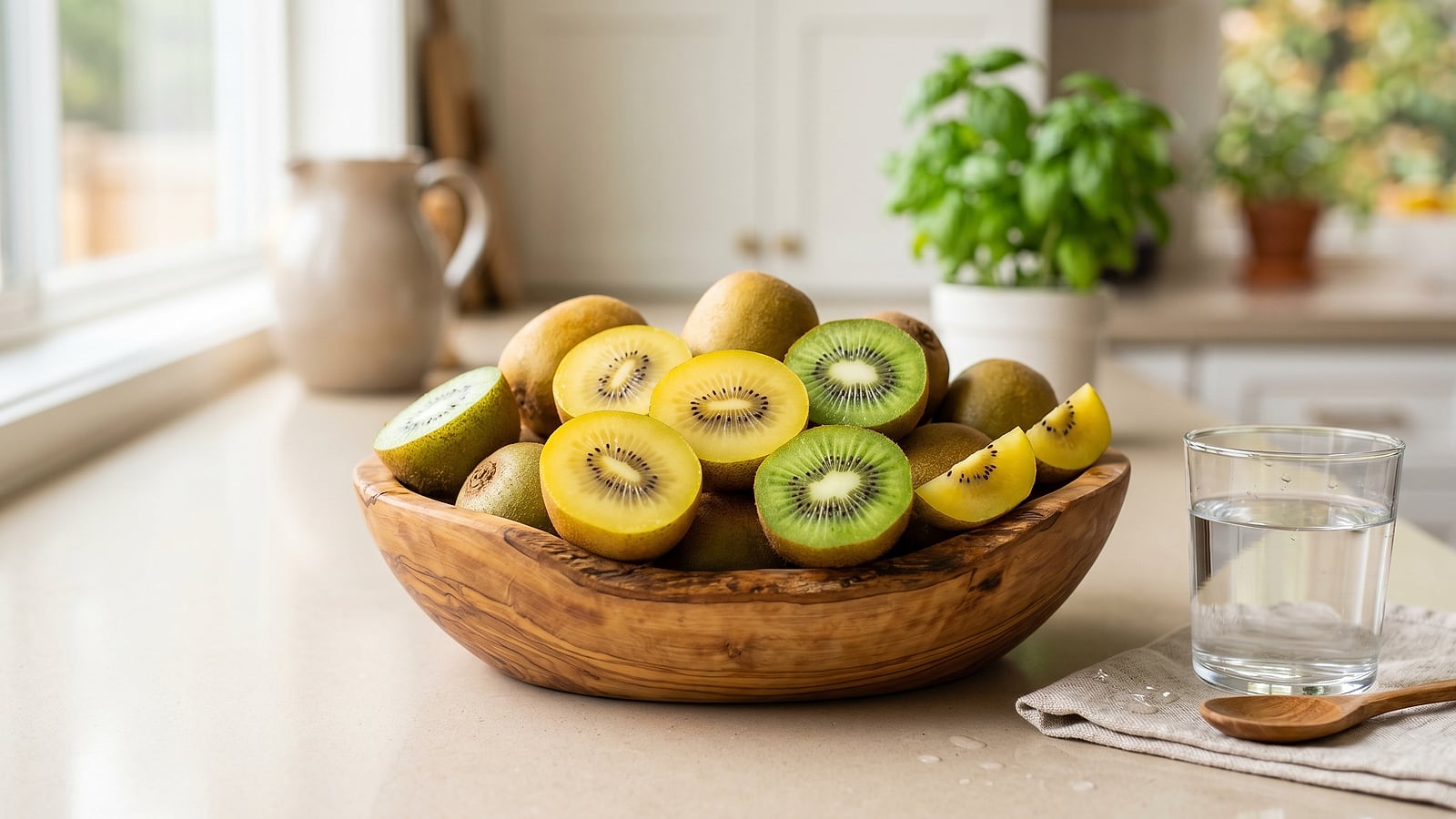
Kiwifruit vs Fiber Supplement: What a 32-Person Trial Found (6.3 vs 4.5 a Week)
A small randomized trial put three gold kiwifruit a day against a standard dose of Metamucil in adults with mild constipation. The kiwifruit weeks produced more complete bowel movements: 6.3 a week against 4.5 on the fiber powder. That is an interesting result, and it is also a 32-person study with industry ties, so this article goes through exactly what was tested, what the numbers can support, and where they stop.
How the trial was built
Eady and colleagues ran a 16-week, randomized, single-blind crossover study in mildly constipated adults. In a crossover design, every participant tries both treatments, so each person serves as their own comparison. That removes a lot of the noise you get when you compare one group of people with a different group.
- Participants: 32 adults with mild constipation, with and without abdominal pain.
- Treatment A: three gold-fleshed kiwifruit (‘Zesy002’) a day for 4 weeks.
- Treatment B: 14.75 g of Metamucil a day, supplying 5 g of dietary fiber, for 4 weeks. The authors used it as a positive control.
- Washouts: 4 weeks between treatments, plus 2 weeks at the start and end.
- Main outcome: complete spontaneous bowel movements per week, recorded in daily diaries. A CSBM is one that happens without a laxative and feels complete.
- Secondary outcomes: bowel movement frequency, stool form, digestive symptoms and comfort.
One detail worth noticing: the supplement dose was 5 g of fiber a day. That is a standard serving, but it is a modest one. A different dose of psyllium could behave differently, and the trial cannot tell us how.
The numbers, side by side
| Measure | Three gold kiwifruit a day | Metamucil (5 g fiber a day) |
|---|---|---|
| CSBM per week | 6.3 (vs 3.3 at baseline, P < 0.05) | 4.5 (kiwifruit higher, P < 0.05) |
| Stool consistency and straining | Softer stools, less straining (P < 0.05) | Not reported as improved in the abstract |
| Abdominal pain, indigestion | Improved vs baseline (P < 0.05) | Not reported as improved in the abstract |
| Constipation symptom score | Improved vs baseline (P < 0.05) | Improved vs baseline (P < 0.05) |
The “not reported as improved in the abstract” cells deserve care. They mean the abstract only lists what reached significance, not that nothing changed. According to the authors, kiwifruit was associated with an increase of about two CSBM per week and a reduction in gastrointestinal discomfort. Metamucil improved the constipation score but did not appear in the abstract’s list for pain or indigestion.
How far a 32-person trial can take you
A fair reading has to hold two things at once. The design is good: randomized, crossover, with a real comparator, and a clear primary outcome. But the limits are real.
| Strength | Limit |
|---|---|
| Crossover: each person is their own control | Only 32 people, so individual variation can swing averages |
| A real comparator (psyllium), not just placebo | Single-blind: a fruit and a powder cannot be disguised, so expectations may play a role |
| Daily bowel diaries and a defined primary outcome | Diaries are self-reported |
| Washout periods between treatments | 4 weeks per treatment tells us nothing about long-term use |
| Peer reviewed, published in a nutrition journal | Authors include an employee of Zespri International, a company that sells kiwifruit |
The competing-interest point does not make the result wrong. It does mean that independent replication would count for more than another study from the same group. And a gold kiwifruit variety may not be the one at your grocery store, so the result is best read as “kiwifruit, in this form, seemed to help” rather than as a guarantee for any fruit you pick up.
What the larger trial adds
A bigger study published in 2023 (Gearry and colleagues) recruited 63 healthy adults, 60 people with functional constipation and 61 with constipation-predominant IBS at several international centers. They ate two green kiwifruit or 7.5 g of psyllium a day for four weeks each, with a four-week washout between.
Its abstract reports that green kiwifruit was associated with a clinically relevant rise of at least 1.5 CSBM a week (1.53 in functional constipation, 1.73 in IBS-C), with better gut-comfort scores and no significant adverse events. It does not report a direct kiwifruit-versus-psyllium difference in the abstract, so it would be wrong to say it confirmed the “fruit beats powder” result. What it does add is a larger sample, a different kiwifruit, and people with diagnosed constipation conditions. Zespri was the principal sponsor of this trial too.
If you want the how-to side of this evidence, including amounts, ripeness and a way to track your own results, see our practical guide to kiwifruit for constipation: how many and for whom.
What kiwifruit did not do
The constipation results are the best-supported part of the story. Beyond that, the evidence thins out quickly.
- Cholesterol: a 2024 systematic review and meta-analysis of six randomized trials found kiwifruit lowered LDL cholesterol by 9.30 mg/dL on average (95% CI -17.56 to -1.04).
- Everything else it measured: triglycerides, total cholesterol, HDL, fasting glucose, C-reactive protein, body weight, BMI and waist circumference showed no significant change.
- Big-disease claims: a 2021 review of kiwifruit composition and biological activity concluded that clinically significant effects on the prevention or treatment of major chronic diseases are not yet evident.
- Upper-gut comfort: a 2022 scoping review of 12 trials (661 participants) found good evidence that green kiwifruit may reduce abdominal discomfort and pain, with some evidence for indigestion. It also noted that only 5 of the 12 trials used the same symptom scale and called for more research.
That is a fair summary: a useful food for regularity and gut comfort, with a small effect on LDL, and no support in these studies for weight loss or blood-sugar claims.
Fruit or powder: a practical comparison
The trial asks which did better on average. Your decision also depends on cost, convenience and how your gut handles each. Here is how the two options compare on the points the evidence and common sense can speak to.
| Question | Kiwifruit | Psyllium powder |
|---|---|---|
| Dose tested | 3 gold (2019) or 2 green (2023) a day | 14.75 g Metamucil, 5 g fiber (2019); 7.5 g psyllium (2023) |
| Evidence for regularity | Two randomized crossover trials | Used as a comparator in both; also improved constipation scores in the 2019 trial |
| Other benefits in the studies | Less abdominal discomfort; small LDL change in a meta-analysis | See our review of psyllium and cholesterol |
| Main practical hurdle | Eating 2 to 3 pieces of fruit daily; needs to be ripe | Mixing and drinking a thick fluid with enough water |
| Main caution | Allergy; potassium and sugar if restricted | Needs adequate fluid; ask a pharmacist about timing with medicines |
Nothing here says you must choose one. The trials tested them separately, so there is no evidence about using both. If you want to change one thing at a time and see what happens, start with whichever you will actually stick with. Our guide to how much fiber is too much covers the overall daily target either way.
Who should skip or ask first
- Kiwi or latex-fruit allergy. Kiwifruit is a known allergen. Itching or tingling in the mouth or throat means stop; swelling or trouble breathing needs emergency care.
- Restricted potassium or sugar. If a clinician has asked you to limit either, check how much fruit fits before eating two or three a day.
- New or severe bowel changes. Blood in the stool, black stools, severe pain, unexplained weight loss or a sudden change that persists need a medical evaluation. Those are not “try fruit” situations.
- Medicine timing. If you take a fiber supplement and daily medication, ask a pharmacist about spacing them.
- Children and pregnancy. The trials covered adults, so ask the relevant clinician first.
Questions people ask
Did kiwifruit really beat Metamucil?
In one 32-person crossover trial, yes: 6.3 versus 4.5 complete spontaneous bowel movements a week, with a significant difference. A larger 2023 trial used psyllium as a comparator, but its abstract does not report a head-to-head winner, so the claim rests on one small study.
Green or gold kiwifruit: does it matter?
Both have trial evidence at different doses: three gold a day in the 2019 trial, two green a day in the 2023 trial. A 2022 review examined both but did not declare a clear winner. Pick the one you will eat daily.
Can I take a kiwifruit supplement instead of the fruit?
The constipation trials used whole fresh fruit, not capsules, so those results do not apply to supplements. Start with the fruit.
How long until I notice a difference?
Each treatment in the trials ran for four weeks. The abstracts do not say how soon the effect appears, so give it a few weeks of steady eating, and see a clinician if nothing changes or symptoms are severe.
Verified sources
- Eady SL, Wallace AJ, Butts CA, et al. The effect of ‘Zesy002’ kiwifruit (Actinidia chinensis var. chinensis) on gut health function: a randomised cross-over clinical trial. J Nutr Sci. 2019;8:e18. PMID 31080591
- Gearry R, Fukudo S, Barbara G, et al. Consumption of 2 green kiwifruits daily improves constipation and abdominal comfort: results of an international multicenter randomized controlled trial. Am J Gastroenterol. 2023;118(6):1058-1068. PMID 36537785
- Bayer SB, Frampton CM, Gearry RB, Barbara G. Habitual green kiwifruit consumption is associated with a reduction in upper gastrointestinal symptoms: a systematic scoping review. Adv Nutr. 2022;13(3):846-856. PMID 35266507
- Pam P, Goudarzi MA, Ghotboddin Mohammadi S, et al. The effects of kiwifruit consumption on anthropometric and cardiometabolic indices in adults: a systematic review and meta-analysis. Food Sci Nutr. 2024;12(10):7017-7032. PMID 39479621
- Wang S, Qiu Y, Zhu F. Kiwifruit (Actinidia spp.): a review of chemical diversity and biological activities. Food Chem. 2021;350:128469. PMID 33485721
Keep reading
This article is for education only and is not medical advice. Talk to a qualified clinician before changing your diet if you have a medical condition or take medication.
Bloated, tired, foggy, or fighting cravings?
Get The Gut Reset free — a science-backed guide to go from “off” to clear, light and energized. Drop your email and we’ll send it straight to your inbox.
No spam. Unsubscribe anytime. Educational content, not medical advice.