
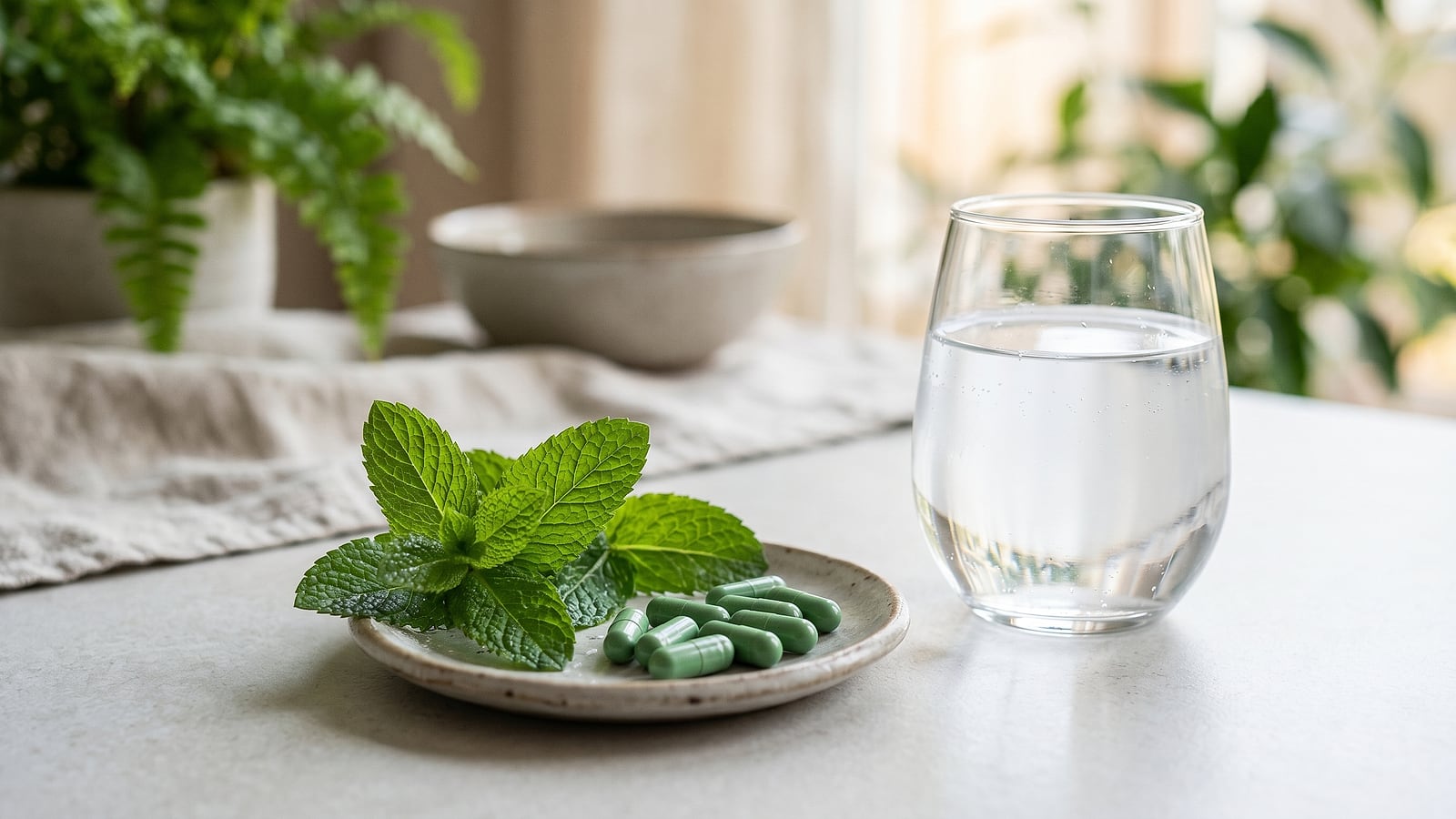
Does peppermint oil actually work for IBS? The honest answer from the trials
Peppermint oil is one of the most popular natural remedies for irritable bowel syndrome (IBS). It is also one of the most argued-about. The trials do not fully agree. So let’s go through the real questions, with what the evidence actually says.
Does peppermint oil actually relieve IBS symptoms?
Mostly, the evidence says yes — with a caveat. A 2022 analysis pooled 10 randomized trials (about 1,030 people). Peppermint oil beat placebo for overall IBS symptoms and for stomach pain [PMID: 35942669]. The “number needed to treat” was about 4 for overall symptoms. That means roughly 1 in 4 people get real relief they would not have gotten from a placebo [PMID: 35942669]. An earlier analysis of 12 trials found a similar benefit [PMID: 30654773].
Now the caveat. A well-run 2021 US trial found NO significant difference between peppermint oil and placebo — both groups improved a lot [PMID: 34319275]. So the honest summary is this: the pooled evidence favors peppermint oil, but it is not a sure thing for everyone, and a strong trial came up empty.
How does it work?
Peppermint oil is an antispasmodic — it relaxes the muscle in the gut wall. Lab studies show it does this by blocking calcium from flowing into the muscle cells, much like a calcium-channel blocker medicine [PMID: 1646142]. Less calcium means less cramping and spasm. That is why it tends to help pain and the “gut in knots” feeling more than it changes things like how often you go.

Is it safe? What are the side effects?
It is generally well-tolerated, but not side-effect-free. In the 2022 analysis, people taking peppermint oil had MORE side effects than placebo — most often heartburn or reflux [PMID: 35942669]. That happens because peppermint also relaxes the valve at the top of the stomach. The fix most studies use is enteric-coated capsules, which are built to open lower down in the gut instead of in the stomach.
So should you try it?
It is a reasonable, low-cost thing to try for IBS — especially for cramping and pain — as long as you keep expectations honest. The studies used enteric-coated capsules, often around 180 to 225 mg, two to three times a day [PMID: 34319275]. Give it a few weeks.
Talk to a doctor first if you have reflux or GERD (it can worsen heartburn), a hiatal hernia, are pregnant, or take other medicines. And never assume it is IBS without a proper diagnosis, because other conditions can look like it. If it gives you heartburn, that is the known trade-off of this remedy.
The honest bottom line
Peppermint oil is one of the better-studied natural options for IBS, and the overall evidence leans positive [PMID: 35942669][PMID: 30654773]. But it is not universal, a strong recent trial found nothing [PMID: 34319275], and it can cause heartburn. An older review said it well: promising, but not proven beyond doubt [PMID: 9672344]. Worth a careful try — not a guaranteed cure.
Verified Sources
- Systematic review and meta-analysis: efficacy of peppermint oil in irritable bowel syndrome. — Alimentary pharmacology & therapeutics, 2022 (PMID 35942669)
- Peppermint Oil Treatment for Irritable Bowel Syndrome: A Randomized Placebo-Controlled Trial. — The American journal of gastroenterology, 2021 (PMID 34319275)
- The impact of peppermint oil on the irritable bowel syndrome: a meta-analysis of the pooled clinical data. — BMC complementary and alternative medicine, 2019 (PMID 30654773)
- Peppermint oil for irritable bowel syndrome: a critical review and metaanalysis. — The American journal of gastroenterology, 1998 (PMID 9672344)
- The mechanism of action of peppermint oil on gastrointestinal smooth muscle. — Gastroenterology, 1991 (PMID 1646142)
Bloated, tired, foggy, or fighting cravings?
Get The Gut Reset free — a science-backed guide to go from “off” to clear, light and energized. Drop your email and we’ll send it straight to your inbox.
No spam. Unsubscribe anytime. Educational content, not medical advice.
professional before changing your diet, supplements, or treatment. These statements have not been
evaluated by the Food and Drug Administration and are not intended to diagnose, treat, cure, or prevent any disease.