

Old cultures sweated in heat for a reason — decades of Finnish data show regular sauna use nearly halves the risk of heart death
My grandmother in the Andes used to say that sweat washes the heart before it washes the skin. For centuries, cultures from the Arctic to the high valleys of Peru built sweat lodges and wood-fired saunas. They treated heat not as a luxury, but as something the body needed. Today, we call this thermotherapy (heat-based therapy). But the core truth hasn’t changed: our ancestors knew how to use heat with nothing but hot rocks and heavy air.
Now, the data has caught up. Decades of careful tracking in Finland show that regular sauna use doesn’t just feel good — it is linked to a much lower risk of sudden cardiac death. By the end of this article, you will know the exact temperature, timing, and hydration steps needed to get these heart-protecting benefits at home.
Why This Matters Today
We live in an era of constant, comfortable temperature control. We move from air-conditioned offices to climate-controlled cars, rarely letting our bodies feel real heat. This has a cost.
Our blood vessels can grow less flexible over time because they are never pushed to fully expand. The numbers are sobering. Heart disease remains a leading cause of death — but studies that followed large groups of people over many years point to a striking counter-strategy.
One review of observational and clinical studies found that frequent sauna use (four to seven times per week) is linked to a lower risk of fatal heart events and death from all causes, compared with less frequent use. The specific size of that reduction should be credited to the individual studies cited within that review. [PMID: 30077204] Think about that. A simple, passive heat ritual may rival some advanced medical treatments. This isn’t about expensive gadgets. It’s about reclaiming an ancient physical practice that modern life has taken away.

The Science Behind It
When you step into a 176°F (80°C) sauna, your body doesn’t just sweat. It launches a coordinated response to protect your heart and blood flow. According to one analysis that combined results from multiple sauna studies in heart patients, body temperature rose by about 0.94°C in the first 30 minutes of sauna exposure. [PMID: 32814462] To shed that extra heat, your brain tells your heart to pump harder and faster. Your heart rate climbs by an average of 17 to 18 beats per minute. [PMID: 32814462]
At the same time, your blood vessels widen. Your systolic blood pressure (the top number) drops by roughly 5.5 mmHg, and your diastolic pressure (the bottom number) dips by about 6.5 mmHg during the session. [PMID: 32814462] This closely mirrors what happens during moderate exercise, which is why researchers call passive heat a vascular workout — a workout for your blood vessels.
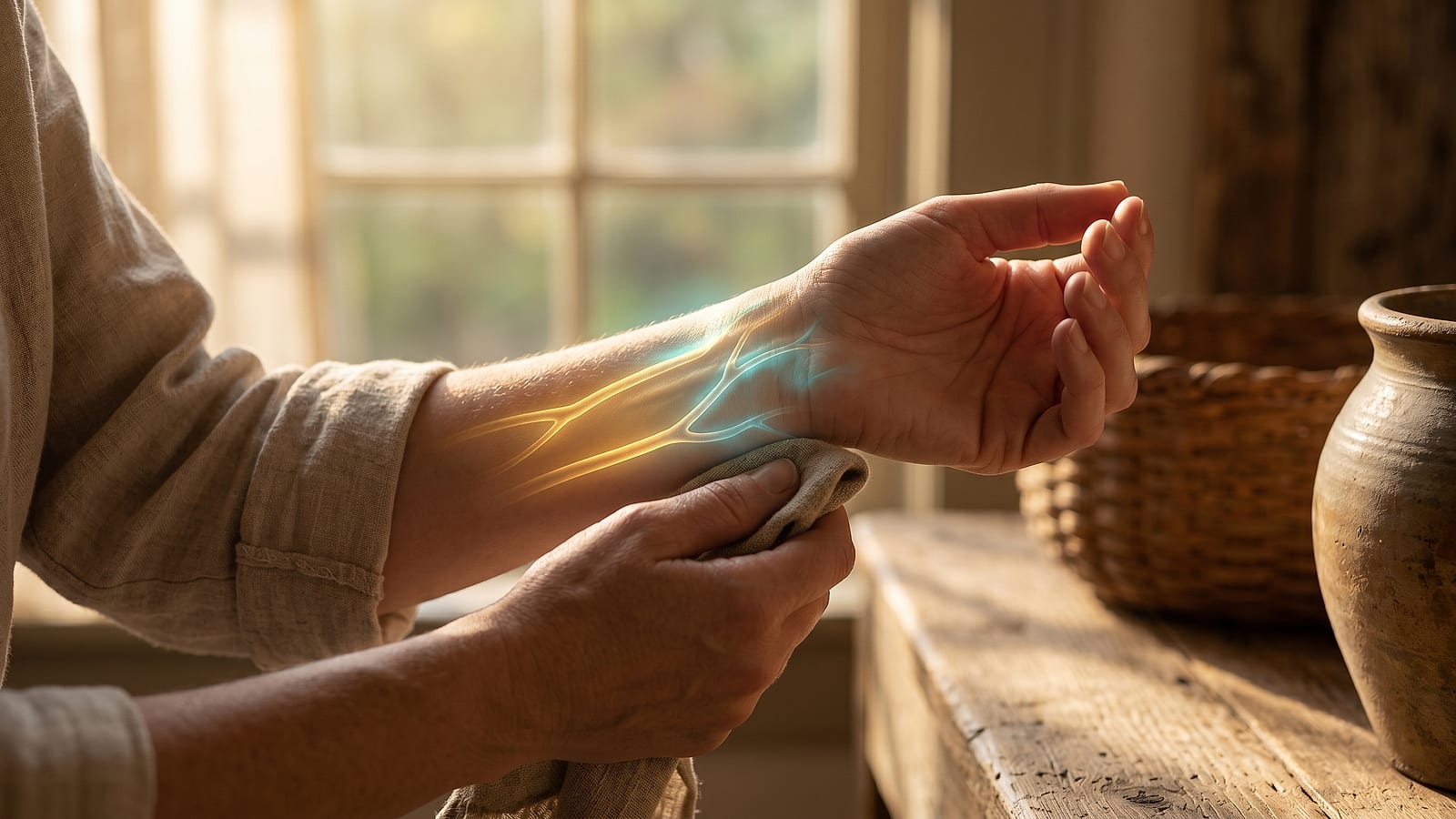
The most important effects happen at the cellular level, inside the endothelium — the thin inner lining of your blood vessels. As your heart pumps faster, blood moves against the vessel walls with more force. This friction, called shear stress, triggers the release of nitric oxide, a compound that relaxes and widens your arteries. One small observational study found that middle-aged adults (8 participants) showed blood vessel responses to a single sauna session that were similar to those seen in young adults (10 participants). This suggests that middle-aged blood vessels can still adapt to heat exposure in the short term. [PMID: 38271083]
Over time, this repeated widening may act like a stretching routine for your heart and blood vessels. One small randomized trial (the strongest kind of study) found that eight weeks of structured heat therapy using hot water immersion significantly reduced arterial stiffness — how rigid the arteries are — and improved blood vessel function in young, sedentary adults. [PMID: 27270841] Hot water immersion can actually raise the heart’s output even higher than a dry sauna, by up to 3.7 liters per minute. [PMID: 40332494] But the dry Finnish sauna offers a unique combination of breathing and blood vessel benefits that is hard to match. It is a time-tested method to help keep your arteries flexible and your heart resilient.
The Complete Protocol

Start with the food source
- The Prep: To prime your body with electrolytes and compounds that help widen blood vessels, prepare a traditional infusion of hibiscus and ginger.
- The Recipe: Steep 10 grams of dried hibiscus flowers and 5 grams of fresh ginger root in 500 ml of boiling water for 10 minutes.
- Timing: Drink this warm infusion 30 minutes before your sauna session, on an empty stomach. The anthocyanins (natural plant pigments) in hibiscus act as mild natural ACE inhibitors, which help relax blood vessels. The gingerols in ginger stimulate blood flow to the skin and limbs, helping prepare your vessels for the heat.
Move to the concentrated natural form
- The Source: Organic eucalyptus essential oil.
- Dose: Add exactly 5 drops of 100% pure Eucalyptus globulus oil to a 1-liter wooden bucket of water.
- Application: Ladle this water over the hot sauna stones periodically during your session. When inhaled, eucalyptol — the active compound in eucalyptus — acts as a mild bronchodilator, meaning it gently opens the airways. This helps your lungs take in more oxygen while your heart rate is elevated.
Optional: the supplement form
- The Compound: Coenzyme Q10 (CoQ10) in the active ubiquinol form.
- Dose: Take 100 mg of ubiquinol with a small, fat-containing snack (such as 15 grams of walnuts) 2 hours before your session.
- Specification: Look for a supplement standardized to contain 100% pure ubiquinol without artificial fillers. CoQ10 supports the heart muscle as it does its high-volume pumping work during the session.
When NOT to do this
Avoid sauna therapy if you have severe aortic stenosis (a narrowing of the heart’s main valve), unstable angina (unpredictable chest pain), or have had a heart attack within the last 6 weeks. Pregnant women and people who are prone to dizziness when standing up should also avoid this protocol, as the drop in blood pressure during a session can cause fainting.
Frequently Asked Questions
Can I combine sauna sessions with cold plunges?
Yes, but do it carefully. The contrast — known as the Nordic cycle — causes a brief spike in blood pressure as blood vessels rapidly tighten. If your main goal is improving heart health and lowering blood pressure, stick to the sauna alone, or wait at least 15 minutes before doing a cold plunge.
What if I miss a scheduled session — do I restart the protocol?
No need to restart. The benefits of heat therapy build up over time, much like exercise. If you miss a day, simply pick up where you left off. Aim for 4 sessions of 20 minutes each per week to maintain the benefits to your blood vessels.
How does dry sauna compare to steam rooms for heart health?
Dry saunas run at much higher temperatures (170°F–190°F) than steam rooms (110°F–120°F). Steam can feel hotter because of the humidity, but the dry sauna allows for longer, safer sessions. Those sessions produce a stronger workout for the heart and blood vessels and a greater release of nitric oxide.
Is the CoQ10 supplement necessary if I eat a nutrient-dense diet?
It is not strictly necessary, but it is highly recommended for people over 40. As we age, the body naturally produces less CoQ10. This can make the heart muscle less efficient when it has to work harder — as it does in a 180°F sauna environment.
Verified Sources
- Comparison of thermoregulatory, cardiovascular, and immune responses to different passive heat therapy modalities. — American journal of physiology. Regulatory, integrative and comparative physiology, 2025 (PMID 40332494)
- Acute and short-term efficacy of sauna treatment on cardiovascular function: A meta-analysis. — European journal of cardiovascular nursing, 2020 (PMID 32814462)
- Cardiovascular and Other Health Benefits of Sauna Bathing: A Review of the Evidence. — Mayo Clinic proceedings, 2018 (PMID 30077204)
- Passive heat therapy improves endothelial function, arterial stiffness and blood pressure in sedentary humans. — The Journal of physiology, 2016 (PMID 27270841)
- The vascular response to acute sauna heating is similar in young and middle-aged adults. — Journal of applied physiology (Bethesda, Md. : 1985), 2024 (PMID 38271083)
Bloated, tired, foggy, or fighting cravings?
Get The Gut Reset free — a science-backed guide to go from “off” to clear, light and energized. Drop your email and we’ll send it straight to your inbox.
No spam. Unsubscribe anytime. Educational content, not medical advice.






thank you