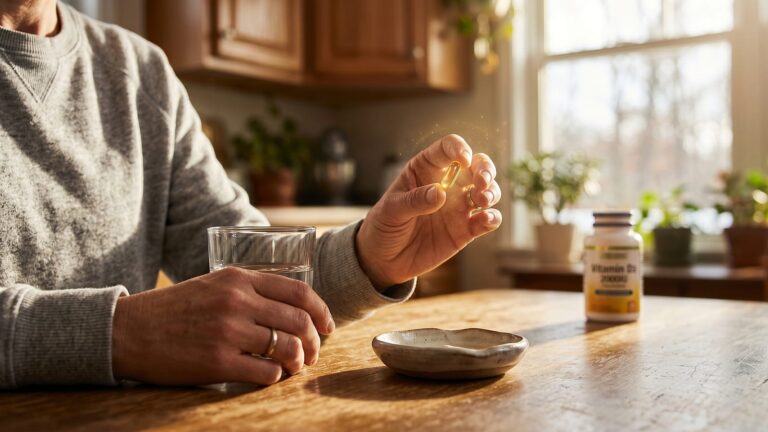

That burning, shooting nerve pain isn’t permanent — your own body makes a compound that calms it, and most doctors never mention it
That burning, shooting nerve pain isn’t permanent. Your own body makes a compound that may help calm it — and most doctors never mention it. People with damaged peripheral nerves (the nerves outside your brain and spinal cord) often describe the feeling as a live electrical wire sparking inside their legs. Standard medicine usually responds with heavy prescription pills that leave you feeling foggy, tired, and disconnected. But your body already has the tools to support this process. This guide walks you through a precise, 30-day natural protocol designed to support your nerve defenses at the cellular level.
This isn’t about masking symptoms with a temporary fix. It’s about understanding what’s happening inside your peripheral nerves. When those nerves are under constant attack, standard treatments try to dull your brain’s sense of pain. An evidence-based approach focuses on the source. By giving your body the exact fatty building blocks it needs, you may help calm the overexcited cellular processes that are keeping you awake at night.
Why This Matters Today
Millions of people live with chronic numbness and tingling from peripheral nerve problems. These problems can be driven by metabolic changes, silent immune issues, or physical compression. The standard treatment model often just masks the signal instead of fixing the underlying problem.
Research links palmitoylethanolamide — or PEA — to strong clinical results for nerve and body pain [39839988]. PEA is not an experimental lab chemical. It is a protective fatty acid (a type of fat-based molecule) your body makes on demand to help cells handle injury. But because PEA cannot be patented like a drug, it rarely makes it into the average doctor’s toolkit.
A 2025 meta-analysis (a study that combines results from many trials) found that PEA significantly reduced pain scores at 6 weeks, 8 weeks, and up to 26 weeks. It also improved physical quality of life [39798151]. Let’s look at the cellular machinery that makes this compound work.

The Science Behind It
Here’s what is actually happening inside your tissue. When a peripheral nerve is compressed, irritated, or starved of oxygen, it doesn’t suffer quietly. It sends out a distress signal. That signal triggers inflammatory immune cells — mainly mast cells and microglia — to rush to the area.
Think of mast cells as tiny chemical grenades. When they burst open, they release histamine and inflammatory proteins called cytokines directly onto the nerve sheath (the protective covering around a nerve). This bursting process is called degranulation. It keeps the nerve in a constant state of over-excitement. Your brain registers this chemical storm as a continuous, burning ache. Research links PEA to directly blocking mast cell degranulation [22697514]. It may help coax these immune cells to stop adding fuel to the fire.

PEA also goes deeper than calming the immune storm. It acts as a disease-modifying agent by working through a specific receptor inside your cell’s nucleus called PPAR-alpha (a protein that acts like a master switch for inflammation). When PEA binds to this receptor, it helps turn off the genetic instructions that drive inflammation. This two-part action is vital. PEA doesn’t just dull pain — it may help preserve the actual structure of the nerve [23533304]. Typical painkillers reduce pain signals. PEA may help address the underlying inflammatory process.
This receptor activation may also help protect the myelin sheath — the insulating layer that wraps around your nerves. Think of it like the plastic coating on an electrical cord. When that coating frays, sparks fly. By supporting PPAR-alpha, PEA may help your body maintain this protective barrier. That could reduce the erratic electrical misfires you feel as shooting pain. Clinical data confirms that even short-term use of ultramicronized PEA (a very finely ground form that absorbs better) is linked to significant, measurable relief for peripheral neuropathic pain [24967102]. The super-fine particle size means your body can absorb the compound before local enzymes break it down.
This is why PEA is fundamentally different from synthetic pain blockers. It works in harmony with your cell membranes. Your body already recognizes this lipid (fat-based molecule), so it does not stress your liver or kidneys the way long-term NSAID use does. Instead, it replenishes a depleted local supply of protective molecules, helping restore balance. It is a biological correction, not a chemical override.
The Complete Protocol

Start with the food source
- Eat 2 pasture-raised egg yolks daily. Cook them gently so the yolks stay runny — high heat damages the delicate fats. Egg yolks are one of nature’s richest dietary sources of palmitoylethanolamide.
- Eat 100 grams of steamed cold-water fish — such as wild-caught sardines or mackerel — three times per week. These provide the essential fatty acid building blocks your cells need to make their own PEA.
- Add 30 grams of raw, unroasted peanuts to your daily diet. Peanuts contain small amounts of natural PEA and beneficial plant sterols. Eat them as a mid-morning snack.
Move to the concentrated natural form
- Use premium, cold-pressed extra virgin olive oil as your main fat. Take exactly 2 tablespoons (30 ml) daily, drizzled over warm food. Do not cook with it at high heat. High-quality olive oil contains a related compound called oleoylethanolamide, which may help PEA bind more effectively to its receptor.
Optional: the supplement form
- Choose an ultramicronized PEA (PEA-um) supplement. This specific particle size is essential for proper absorption in the gut. Make sure the label states at least 98% pure active palmitoylethanolamide.
- Take 600 mg of ultramicronized PEA twice daily. Take the first dose within 30 minutes of waking, on an empty stomach. Take the second dose 30 minutes before dinner.
- Always pair each dose with a small amount of healthy fat — such as a teaspoon of coconut oil or a few slices of avocado. This helps your body absorb the supplement through the lymphatic system (the network that carries fats from your gut into your bloodstream). Keep this dose for 8 weeks before reassessing.
PEA dissolves in fat, not water. Taking it with water alone means most of it will pass right through you. Always take it with a spoonful of fat to trigger bile release and proper absorption.
When NOT to do this
- Do not use PEA supplements if you are pregnant or breastfeeding. There is not enough safety data for these groups.
- If you take high-dose prescription blood thinners, talk to your doctor before starting PEA. While PEA is generally well tolerated, compounds that affect fat metabolism can subtly influence how platelets behave.
Stop use right away if you experience mild stomach upset. This happens in fewer than 2% of clinical trial participants, but it can occur if your body is slow to digest fats.
Frequently Asked Questions
Can I combine PEA with my current prescription gabapentin?
Yes. In clinical trials, ultramicronized PEA was often used alongside standard neuropathic medications [24967102]. It does not compete for the same metabolic pathways. Many patients find that adding PEA allows them to gradually lower their prescription dose under medical supervision, which can reduce side effects.
What if I miss a dose of PEA — do I need to restart the 30-day protocol?
No, do not restart. PEA works by building up a steady level in your peripheral tissues over time. If you miss a dose, simply take your next scheduled dose as normal. Do not double up — your cells can only process a certain amount of fat-based compounds at once.
Can I just eat egg yolks and peanuts instead of taking the supplement?
For mild, occasional nerve irritation, dietary sources are a good option. However, for chronic, burning neuropathic pain, food alone cannot deliver the amounts used in clinical trials. You would need to eat dozens of egg yolks daily to match the 1,200 mg clinical dose, so supplementation becomes necessary for a therapeutic effect.
Is there a difference between micronized and regular PEA supplements?
Yes — a significant one. Standard PEA has large particles that the human gut absorbs poorly. Ultramicronized PEA (PEA-um) has been mechanically ground into very fine particles, which allows it to cross the intestinal wall more easily [24967102]. Regular PEA is largely wasted, while the micronized form reaches your nerves.
Verified Sources
- Palmitoylethanolamide is a disease-modifying agent in peripheral neuropathy: pain relief and neuroprotection share a PPAR-alpha-mediated mechanism. — Mediators of inflammation, 2013 (PMID 23533304)
- Short-term efficacy of ultramicronized palmitoylethanolamide in peripheral neuropathic pain. — Pain research and treatment, 2014 (PMID 24967102)
- Palmitoylethanolamide is a new possible pharmacological treatment for the inflammation associated with trauma. — Mini reviews in medicinal chemistry, 2013 (PMID 22697514)
- Meta-Analysis of Palmitoylethanolamide in Pain Management: Addressing Literature Gaps and Enhancing Understanding. — Nutrition reviews, 2025 (PMID 39798151)
- Palmitoylethanolamide supplementation for human health: A state-of-the-art systematic review of Randomized Controlled Trials in patient populations. — Brain, behavior, & immunity – health, 2025 (PMID 39839988)
Bloated, tired, foggy, or fighting cravings?
Get The Gut Reset free — a science-backed guide to go from “off” to clear, light and energized. Drop your email and we’ll send it straight to your inbox.
No spam. Unsubscribe anytime. Educational content, not medical advice.