Does Gargling Water Prevent Colds? What the Japanese Trial and the Reviews Found
In a Kyoto randomized trial of 387 healthy volunteers, people who gargled plain tap water at least three times a day had 36% fewer first colds over 60 days than people who changed nothing. That trial tested prevention, not treatment, and it was open-label. Gargling has not been shown to cure a cold you already have.
What did the Kyoto gargling trial actually test?
The study behind the viral “Japanese gargling” claim is Satomura and colleagues at Kyoto University, published in the American Journal of Preventive Medicine in 2005 (PMID 16242593). Gargling is a common daily habit in Japan, and many people believe it prevents colds, especially with a medicated gargle. The authors noted that nobody had proved it in a clinical trial.
Here is what they actually did:
- They recruited 387 healthy volunteers aged 18 to 65 and ran the study during the 2002-2003 winter.
- Participants were randomly assigned to one of three groups: gargling with water, gargling with diluted povidone-iodine, or usual care as the control.
- The two gargling groups were asked to gargle at least three times a day.
- Everyone was followed for 60 days and kept a self-written symptom record.
- The main outcome was how often a first upper respiratory tract infection (URTI) occurred, with symptom severity as a second outcome. Analysis was by intention to treat.
Two details matter. First, these were healthy people trying to avoid getting sick, so this is a prevention study. Second, the control group simply carried on as usual, with no placebo gargle. Everyone knew which group they were in, and the outcomes were self-reported symptoms, so expectations may have played a part. The abstract does not say whether infections were confirmed by a lab test.
What were the results, and how strong are they?
A total of 130 participants contracted a URTI during the 60 days. The incidence of a first URTI was 0.26 episodes per 30 person-days in the control group. It fell to 0.17 in the water-gargling group.
- Incidence rate ratio for water gargling versus control: 0.64 (95% CI 0.41 to 0.99), which is where the 36% figure comes from. It is our arithmetic on the reported ratio.
- Cox regression hazard ratio: 0.60 (95% CI 0.39 to 0.95), which agreed with the main analysis.
- Severity: among people who did get sick, water gargling tended to ease bronchial symptoms (p = 0.055), which falls just short of the usual cut-off for significance.
The authors concluded that simple water gargling was effective in preventing URTIs among healthy people and called it a virtually cost-free option. That is a fair reading of a statistically significant result. It is also a single trial with confidence intervals that nearly touch 1.0, so the true effect could be small. The study is two decades old, and we found no larger replication in the abstracts we reviewed.
Why did plain water beat the iodine gargle?
This is the surprising part. The povidone-iodine group, which is the antiseptic gargle many people assume is stronger, had a rate of 0.24 episodes per 30 person-days. The rate ratio against control was 0.89 (95% CI 0.60 to 1.33), which means it was not statistically distinguishable from doing nothing.
The abstract does not explain why, and we will not invent an explanation. People may have found the iodine unpleasant and used it less, but the abstract does not report adherence, so that is only a guess. What we can say is that in this trial an antiseptic did not outperform water. Trial participants were also not blinded, so these comparisons should be read as signals rather than proof.
The trial is also not a license to treat gargling as a shield. Gargling reaches the back of the mouth and throat, not the nose, where many colds begin. The abstract describes no mechanism, and washing virus off the throat is the idea behind the habit rather than something this trial measured.
Does gargling help once you already have a cold?
That is a different question, and the evidence is thinner. The most relevant work uses salty water, not plain water, and combines gargling with nasal rinsing.
- Edinburgh pilot (Ramalingam 2019, Scientific Reports, PMID 30705369). Researchers randomized 68 healthy adults within 48 hours of cold onset to hypertonic saline nasal irrigation and gargling or standard care. Of those, 61 provided follow-up data. The intervention group reported illness lasting 1.9 days less (p = 0.01), 36% less use of over-the-counter medicines, and less viral shedding. It was non-blinded and the authors said a larger trial was needed to confirm it.
- ELVIS COVID-19 trial (Yusuf 2024, Journal of Global Health, PMID 39666578). In 576 people with suspected or confirmed COVID-19 in Pakistan, hypertonic saline nasal irrigation and gargling did not speed symptom resolution compared with the control group, who were told to do the washing ritual (wudu) with tap water. The authors concluded it could not be recommended when started within five days of symptoms.
So the honest summary is this: a small pilot hinted at benefit for colds, and a larger trial in a different infection found none. Neither is the Kyoto prevention design, and neither is simple gargling alone. Do not stretch the 36% number to claim gargling shortens a cold.
The large Cochrane review of physical interventions to reduce the spread of respiratory viruses (Jefferson 2023, PMID 36715243) lists gargling among the measures it examined across 78 randomized trials. The abstract reports results for masks, hand hygiene and other measures but does not report a gargling result, so we cannot cite it for or against the habit. We say so in the unverified list below. For the basics of colds and what else has been tested, see our cold season checklist.
What does the evidence say about antibiotics for a cold?
The “enemy” here is a common reflex: asking for antibiotics when a cold drags on. Colds are caused by viruses, and antibiotics act on bacteria. The Cochrane review by Kenealy and Arroll (2013, PMID 23733381) tested that directly.
- It included 11 studies. Six, with up to 1,047 participants, assessed the common cold.
- People who took antibiotics did no better than those on placebo in lack of cure or persistence of symptoms (risk ratio 0.95, 95% CI 0.59 to 1.51).
- Adverse effects were more common with antibiotics (risk ratio 1.8, 95% CI 1.01 to 3.21), and adults had a clearly higher risk (risk ratio 2.62, 95% CI 1.32 to 5.18).
- The authors concluded there is no evidence of benefit for the common cold or for persisting acute purulent rhinitis, and that routine use is not recommended.
This review is about treatment, so it does not say gargling “beats” antibiotics at anything. It says that a bottle of antibiotics is the wrong tool for a common cold. An update to this review was published in November 2025; we only reviewed the 2013 abstract, so check that update for current numbers.

Side by side: four things people try for colds
The table shows what each option was tested for, with who and how many. Do not read down the rows as a ranking, because prevention and treatment trials answer different questions.
| Approach | What was studied | Who and how many | What it showed | How sure can we be? |
|---|---|---|---|---|
| Plain water gargling | Preventing a first URTI over 60 days (Satomura 2005) | 387 healthy volunteers aged 18 to 65 (three groups) | Rate ratio 0.64 (95% CI 0.41 to 0.99) versus usual care | Low to moderate; one open-label trial, self-reported symptoms |
| Povidone-iodine gargling | Same trial, same design | Same volunteers | Rate ratio 0.89 (95% CI 0.60 to 1.33); no clear difference from usual care | Low; one trial |
| Salt water nasal rinse plus gargle | Treating a cold within 48 hours (Ramalingam 2019); treating COVID-19 (Yusuf 2024) | 61 adults with colds; 576 people with COVID-19 | Cold pilot: illness 1.9 days shorter. COVID trial: no benefit on time to symptom resolution | Very low for colds (pilot); the COVID trial was not a cold trial |
| Antibiotics | Treating the common cold (Cochrane 2013) | Six trials, up to 1,047 people | No better than placebo; more adverse effects in adults | Moderate; the review recommends against routine use |
How would you gargle the way it was studied?
If you want to try it, copy the trial rather than the videos.
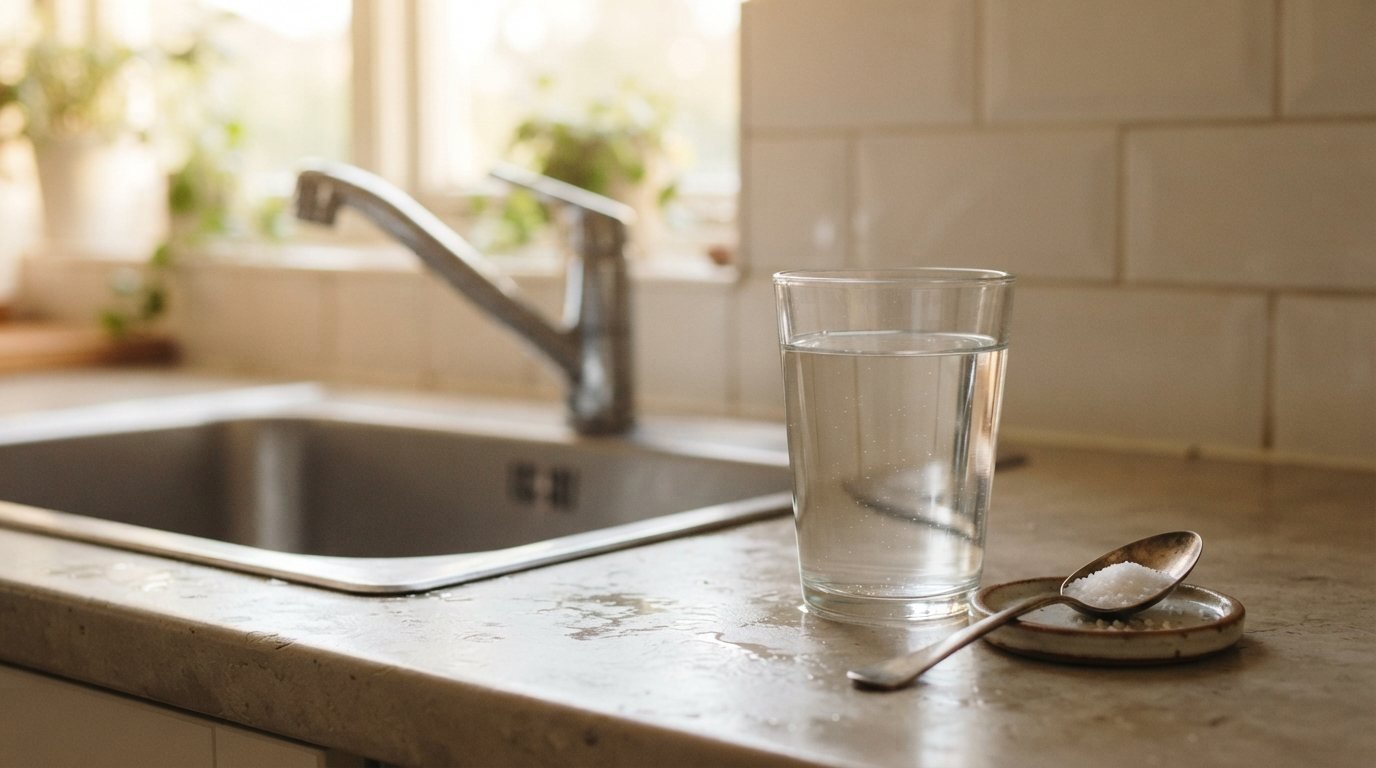
- Use plain tap water. The winning arm was water. The abstract gives no volume, temperature or technique, and we will not make any up.
- Do it often. Participants were asked to gargle at least three times a day for the 60-day follow-up. A once-a-week habit was not tested.
- Treat it as a prevention habit, not a rescue. The volunteers were healthy when they started. The trial did not test starting after symptoms appear.
- Do not add iodine on the assumption that it is stronger. In this trial the iodine arm did not clearly differ from doing nothing.
Gargling does not replace the basics. Hand washing is the measure with the clearest backing in the Cochrane physical interventions review, where hand hygiene was linked to a 14% relative reduction in acute respiratory infections (risk ratio 0.86, 95% CI 0.81 to 0.90; moderate-certainty evidence). If you are building a routine for the cold months, our guides on zinc for the common cold and honey for a cough cover what else has been tested.
What about adding salt?
The Kyoto trial used plain water. Salt appeared in the Edinburgh pilot, where participants prepared a hypertonic saline solution and used it for both nasal irrigation and gargling. The abstract does not give a recipe, so we do not give one either. The COVID-19 trial used a 2.6% saline solution, which is a medical-trial concentration rather than a kitchen pinch. If you want to try salt water, a clinician or pharmacist can suggest a safe strength.
Who should skip it or ask first?
Water gargling is low risk for most adults, but a few groups should check first.
- Young children. Children can swallow or inhale the water. The Kyoto trial enrolled adults only, so it says nothing about kids.
- Anyone who has trouble swallowing or a weak gag reflex. Gargling can send liquid into the airway.
- Povidone-iodine users. If you use an iodine gargle, ask a clinician first if you have thyroid disease, an iodine allergy or are pregnant or breastfeeding. This is general cautionary guidance and was not part of the trial abstract.
- High blood pressure or a sodium-restricted diet. If you gargle with salt water, spit it out rather than swallow it, and ask your care team about the strength.
- Anyone taking antibiotics. Do not stop or start antibiotics because of an article. Ask the prescriber.
A sore throat that lasts more than a week, a fever that keeps rising, trouble breathing or swallowing, a stiff neck, or symptoms in a baby or an older adult with other conditions need a medical visit. Nothing in this article is a substitute for it.
Questions people ask
Does gargling water prevent colds?
In one Kyoto trial of 387 healthy volunteers, water gargling at least three times daily was linked to a 36% lower rate of first respiratory infections over 60 days compared with usual care (rate ratio 0.64, 95% CI 0.41 to 0.99). It is a single open-label trial, so it is encouraging rather than conclusive.
Does gargling help once I already have a cold?
Not proven. The Kyoto trial tested prevention in healthy people. A small Edinburgh pilot of 61 people found shorter illness with salt-water nasal irrigation plus gargling, but its authors asked for a larger trial, and a 576-person COVID-19 trial found no benefit. Plain gargling for treatment has not been shown to work.
Is salt water better than plain water for gargling?
We found no trial that compared them head to head. Plain water was what worked in the Kyoto prevention trial. Salt water appeared in treatment studies combined with nasal rinsing, so any difference cannot be separated from the nose rinse. Without direct evidence, plain water is the best-supported choice for prevention.
Is a povidone-iodine gargle stronger?
Not in the trial we reviewed. The iodine group had a rate ratio of 0.89 (95% CI 0.60 to 1.33) against usual care, which is statistically no different from doing nothing, while water gargling reached 0.64. One trial is not the last word, but it gives no reason to assume the antiseptic is better.
Do antibiotics work for a common cold?
No. A Cochrane review of six trials and up to 1,047 people found antibiotics did no better than placebo for the common cold, and adults had more side effects (risk ratio 2.62). The authors concluded there is no evidence of benefit and do not recommend routine use. Colds are caused by viruses.
How often did people gargle in the study?
The two gargling groups were asked to gargle at least three times a day and were followed for 60 days during the 2002-2003 winter. The abstract does not report how closely people followed that schedule, or how long each gargle lasted, so the real-world habit behind the 36% figure is not fully known.
What we could not verify
- Whether the Kyoto result has been replicated. We found the single trial and no larger confirmation in the abstracts we reviewed.
- How the Kyoto infections were confirmed. The abstract describes self-administered symptom records and does not mention lab tests. Group sizes are also not in the abstract.
- Why water worked and iodine did not. The abstract does not offer a mechanism, and we did not find a study that tested one.
- The Cochrane physical interventions review on gargling. The review lists gargling among its interventions, but the abstract we read does not report a gargling result, so we do not cite one.
- Salt-water recipes. The abstracts give no home-kitchen concentration for the Edinburgh pilot. The COVID-19 trial used a 2.6% solution.
- Other gargle trials. We did not verify other COVID-19 or mouthwash studies and do not use them.
- Safety cautions for iodine, children and swallowing problems. These are general precautions, not findings from the abstracts.
Verified sources
- Satomura K, Kitamura T, Kawamura T, et al. Prevention of upper respiratory tract infections by gargling: a randomized trial. Am J Prev Med. 2005;29(4):302-307. PMID 16242593
- Ramalingam S, Graham C, Dove J, Morrice L, Sheikh A. A pilot, open labelled, randomised controlled trial of hypertonic saline nasal irrigation and gargling for the common cold. Sci Rep. 2019;9:1015. PMID 30705369
- Yusuf OM, Ramalingam S, Norrie J, et al. Hypertonic saline nasal irrigation and gargling for suspected or confirmed COVID-19: pragmatic randomised controlled trial (ELVIS COVID-19). J Glob Health. 2024;14:05027. PMID 39666578
- Kenealy T, Arroll B. Antibiotics for the common cold and acute purulent rhinitis. Cochrane Database Syst Rev. 2013;(6):CD000247. PMID 23733381
- Jefferson T, Dooley L, Ferroni E, et al. Physical interventions to interrupt or reduce the spread of respiratory viruses. Cochrane Database Syst Rev. 2023;1:CD006207. PMID 36715243
This article is for education only and is not medical advice. Talk to a qualified clinician about a cold that lasts more than a week, a high or rising fever, trouble breathing or swallowing, or symptoms in a child, an older adult or someone who is pregnant or has a chronic condition. Do not start or stop any prescribed medicine because of this article.