Pickle Juice for Leg Cramps: What the Trials Actually Found
A sip of pickle juice shortened electrically induced foot cramps by about 37% compared with water in a 2010 laboratory study of dehydrated men, and sips at cramp onset eased cramp severity in an 82-patient trial in cirrhosis. No trial has tested it on ordinary 2 a.m. leg cramps, and the evidence for magnesium pills is weaker still.
What did the pickle juice lab trial really test?
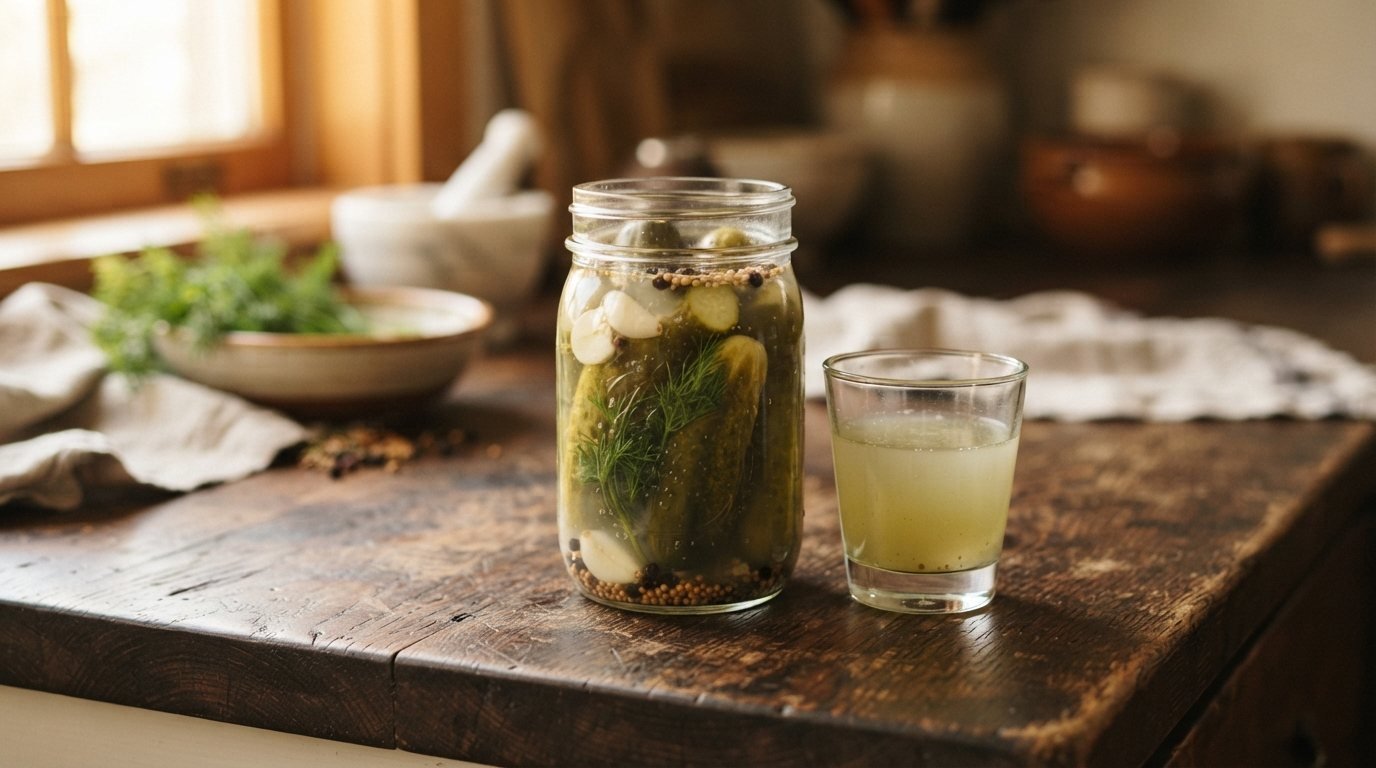
The study behind the viral claim is Miller and colleagues, published in Medicine & Science in Sports & Exercise in 2010 (PMID 19997012). Before it, the idea that a small amount of pickle juice relieves cramps within about 35 seconds was, in the authors’ words, anecdotal.
Here is what the researchers actually did:
- They worked with hypohydrated men, dehydrated to roughly 3% of body weight.
- They induced a cramp in the flexor hallucis brevis, a small muscle in the foot, by electrically stimulating the tibial nerve behind the ankle.
- Thirty minutes later they induced a second cramp and, immediately afterward, gave the men 1 mL of fluid per kilogram of body weight (about 74 mL, roughly 2.5 ounces) of either pickle juice or deionized water.
Baseline cramps lasted about 152 seconds in both sessions. After drinking, the cramp lasted 84.6 seconds with pickle juice and 133.7 seconds with water, a difference of 49.1 seconds (P < .05). By our arithmetic that is a cramp about 37% shorter. Muscle electrical activity during the cramp did not differ between the fluids.
This is a crossover experiment with a water comparison, which is useful. But it is also a very specific situation, and it is not the same as the cramp that wakes you at night. The cramps were created by a machine in a small foot muscle, not in a calf. The participants were dehydrated men, and the abstract does not report how many there were. And the outcome was how long a lab-induced cramp lasted, not how often real cramps happen.
Why might a sip work so fast?
The same research group reported that the effect was too quick to come from the gut. In the 2010 paper, plasma sodium and fluid balance barely changed five minutes after the drink. The authors suspect a reflex that starts in the mouth and throat and calms the nerve cells firing the cramping muscle. That is a hypothesis, not a demonstrated mechanism.
Two follow-up studies fit the idea. A 2010 gastric emptying study in ten men (Miller, J Athl Train, PMID 21062184) led the authors to conclude pickle juice does not relieve cramps through a metabolic route. A 2014 crossover study in nine dehydrated, exercised adults (Miller, J Athl Train, PMID 24955622) found that about 79 mL of pickle juice, which contained roughly 1.5 g of sodium, did not change blood sodium, potassium or osmolality within an hour. It also did not replace the fluid and electrolytes lost in sweat.
Has pickle juice been tested outside the lab?
Once, in a very different population. The PICCLES trial (Tapper and colleagues, American Journal of Gastroenterology, 2022, PMID 35416793) enrolled 82 people with cirrhosis who had more than four muscle cramps in the previous month. They were randomized to sips of pickle juice or tap water at the onset of a cramp, with cramp severity tracked by text message over 28 days.
- Seventy-four patients finished. Average age was 56.6 years.
- On a 0 to 10 cramp scale, severity fell by 2.25 points with pickle juice and 0.36 with water (P = 0.03).
- The share of days with a cramp score under 5 was 46% versus 35%, a difference that was not statistically significant. Sleep quality and overall quality of life did not differ either.
- No adverse events were reported with the pickle juice, and weight change did not differ between groups.
Cirrhosis cramps are a different problem from the idiopathic cramps most people get, and many participants were also using other cramp treatments. The trial is encouraging for that group. It does not show that pickle juice stops a healthy adult’s nightly calf cramp, and we found no randomized trial that tested exactly that.
What did the evidence say about magnesium?
Magnesium is the supplement most people reach for first. The Cochrane review by Garrison and colleagues (2020, PMID 32956536) pooled 11 randomized trials with 735 participants. For idiopathic cramps in older adults, most of them presumed to be nocturnal leg cramps, magnesium and placebo were not meaningfully different.
- Cramps per week at four weeks differed by only 0.18 (95% CI -0.84 to 0.49; 5 studies, 307 participants; moderate-certainty evidence).
- The share of people with at least a 25% drop in cramps was the same as with placebo (RR 1.04, 95% CI 0.84 to 1.29; high-certainty evidence).
- Stomach side effects such as diarrhea were reported by 11% to 37% of people taking magnesium.
The authors concluded it is unlikely that magnesium provides clinically meaningful cramp prevention in older adults. For pregnancy-related leg cramps the trials conflicted and were at high risk of bias. This review looked at magnesium taken daily to prevent cramps, so it says nothing about pickle juice taken once a cramp starts. For other magnesium questions, see our guides on magnesium glycinate vs citrate for sleep and magnesium for migraines.
Why does the FDA warn against quinine for leg cramps?
Quinine is the cautionary tale. The Cochrane review by El-Tawil and colleagues (2015, PMID 25842375) pooled 23 trials with 1,586 participants. Versus placebo, quinine reduced the number of cramps over two weeks by 28%, intensity by 10% and cramp days by 20%, though the authors rated the evidence for cramp number and days as low quality, and cramp duration did not change.
So quinine does something. The problem is the price. The FDA’s quinine product is approved only for malaria. In its 2010 safety communication, the agency said it was acting because of continued reports of serious side effects when the drug was used off-label for night-time leg cramps, including low platelet counts and blood and kidney disorders, and that it should not be used for that purpose. The drug’s label says the risks outweigh any potential benefit for leg cramps. Serious reactions were uncommon in the trials, but they can be rarely fatal.
Side by side: five things people try for cramps
The table lists what each option was tested for, with who and how many. Do not read down the rows as a ranking, because the cramp types and study designs differ.
| Approach | What was studied | Who and how many | What it showed | How sure can we be? |
|---|---|---|---|---|
| Pickle juice | Lab-induced foot cramps (Miller 2010); sips at cramp onset for 28 days (PICCLES 2022) | Dehydrated men, number not in abstract; 82 adults with cirrhosis | Cramp lasted 84.6 s vs 133.7 s with water; severity fell 2.25 vs 0.36 points on a 10-point scale | Low to moderate; one lab experiment and one small trial; nobody tested common night cramps |
| Mustard | Only a blood-chemistry study (Miller 2014) | 9 dehydrated adults | Large amounts did not raise blood sodium or potassium; cramp relief was not measured | No controlled cramp trial found |
| Magnesium pills | Cramp prevention (Cochrane 2020) | 11 trials, 735 people; 271 with idiopathic cramps | No clinically meaningful benefit for older adults; more diarrhea | Moderate to high certainty of little or no effect |
| Quinine | Cramp number, intensity, days (Cochrane 2015) | 23 trials, 1,586 people | 28% fewer cramps, 20% fewer cramp days vs placebo; duration unchanged | Low to moderate; FDA says risks outweigh benefit for leg cramps |
| Stretching | Daily calf and hamstring stretching for 6 to 12 weeks (Cochrane 2021) | 3 trials, 201 adults aged 50+ | Daily calf and hamstring stretching for 6 weeks may reduce severity of night cramps (1.3 points on a 10-cm scale); calf stretching alone made little difference | Low to very low; small trials |
How would you use pickle juice the way it was studied?
If you decide to try it, copy the studies rather than the videos.
- Use a small amount. The lab dose was 1 mL per kilogram of body weight, about 74 mL for the men studied. PICCLES used “sips”; the abstract gives no volume.
- Take it when a cramp starts. Both studies tested the juice during or at the onset of a cramp, not as a daily preventive.
- Swallow it, do not just swish. The authors’ idea involves the mouth and throat, and the studied drink was ingested. Whether holding it in the mouth works is unknown.
What about daily prevention?
Nobody has shown that regular pickle juice prevents cramps. That matters because brine is salty. The 2014 study above found roughly 1.5 g of sodium in about 79 mL. That is a meaningful part of the 2,300 mg daily limit most U.S. dietary guidance suggests, so a daily habit is a different decision from a rare sip.
Who should skip it or ask first?
Pickle brine is concentrated salt and acid. Ask a clinician first if any of these apply.
- High blood pressure, heart failure or a sodium-restricted diet. A small serving can contain well over a gram of sodium.
- Kidney disease or dialysis. Sodium and potassium handling are impaired, and cramps may have a medical cause that needs treatment.
- Diabetes. Brines vary, and some commercial pickles are sweetened; check the label. We did not find trial data on pickle juice in diabetes.
- Pregnancy. Leg cramps are common and the evidence is mixed, so ask your obstetric team about salt and about any cramp remedy.
- Reflux, stomach ulcers or sensitive teeth. The studied juice was acidic.
- Medicines such as diuretics or statins. Some drugs can contribute to cramps, and your clinician may want to adjust them.
Frequent cramps, cramps with weakness, swelling, a swollen or red calf, or cramps that began after a new medicine need a medical visit. Nothing in this article is a substitute for it.
Questions people ask
Does pickle juice stop leg cramps?
It shortened lab-induced foot cramps in dehydrated men from about 134 seconds to 85 seconds compared with water, and eased cramp severity in a trial of 82 people with cirrhosis. No randomized trial has tested it on ordinary night calf cramps, so the honest answer is that it is promising but unproven there.
How fast does pickle juice work for cramps?
In the 2010 lab study the cramp ended about 49 seconds sooner than after water. The effect appeared before the drink could be absorbed, so the authors suspect a nerve reflex from the mouth and throat. That is a hypothesis. Real-world timing in night cramps has not been measured.
Is it the vinegar or the salt?
Nobody knows. In the studies, blood sodium and potassium did not change in the minutes after a small serving, which argues against a salt-replacement effect. The researchers suspect the taste or acidity triggers a reflex in the mouth and throat. We found no trial that separated vinegar, salt and spices.
Can I use mustard instead?
There is no controlled trial showing mustard relieves cramps. The one study we found tested blood chemistry only: a large amount of mustard, containing a similar sodium amount as the pickle juice, did not change blood sodium or potassium in nine dehydrated adults. Whether it helps a cramp was not measured.
Should I take magnesium for night leg cramps?
For older adults with idiopathic night cramps, a 2020 Cochrane review of 11 trials found magnesium unlikely to give clinically meaningful prevention, with stomach upset reported by 11% to 37% of users. Evidence in pregnancy conflicts. If you take magnesium for another reason, talk with a clinician before changing it.
Why does the FDA warn against quinine for cramps?
Quinine reduced cramp numbers by about 28% in trials, but the FDA said serious blood and kidney problems were reported when it was used off-label for night leg cramps. The agency stated it should not be used for that purpose, and the drug’s label says the risks outweigh any benefit. The only approved use is malaria.
What we could not verify
- Pickle juice for night cramps in healthy adults. We found no randomized trial of it for spontaneous nocturnal leg cramps outside cirrhosis. The Miller 2010 cramps were induced electrically in a foot muscle.
- The size of the 2010 study. The abstract does not state the number of participants, so we do not give one.
- Why it works. The mouth-and-throat reflex is the authors’ suspicion. We did not find a study that confirmed it, and we did not verify other proposed mechanisms.
- Mustard and commercial cramp shots. We found no controlled cramp trial of either.
- The FDA wording. We confirmed the 2010 safety communication and the product label through summaries and the FDA label file, and could not open every FDA page directly. An earlier 2006 FDA action mentioned online was not verified.
Verified sources
- Miller KC, Mack GW, Knight KL, et al. Reflex inhibition of electrically induced muscle cramps in hypohydrated humans. Med Sci Sports Exerc. 2010;42(5):953-961. PMID 19997012
- Tapper EB, Salim N, Baki J, et al. Pickle juice intervention for cirrhotic cramps reduction: the PICCLES randomized controlled trial. Am J Gastroenterol. 2022;117(6):895-901. PMID 35416793
- Miller KC, Mack GW, Knight KL. Gastric emptying after pickle-juice ingestion in rested, euhydrated humans. J Athl Train. 2010;45(6):601-608. PMID 21062184
- Miller KC. Electrolyte and plasma responses after pickle juice, mustard, and deionized water ingestion in dehydrated humans. J Athl Train. 2014;49(3):360-367. PMID 24955622
- Garrison SR, Korownyk CS, Kolber MR, et al. Magnesium for skeletal muscle cramps. Cochrane Database Syst Rev. 2020;9:CD009402. PMID 32956536
- El-Tawil S, Al Musa T, Valli H, et al. Quinine for muscle cramps. Cochrane Database Syst Rev. 2015;4:CD005044. PMID 25842375
- Hawke F, Sadler SG, Katzberg HD, et al. Non-drug therapies for the secondary prevention of lower limb muscle cramps. Cochrane Database Syst Rev. 2021;5:CD008496. PMID 33998664
- U.S. Food and Drug Administration. Qualaquin (quinine sulfate) prescribing information, boxed warning and limitations of use (2019 label). accessdata.fda.gov
- U.S. Food and Drug Administration. Serious risks associated with using quinine to prevent or treat nocturnal leg cramps (news for health professionals). fda.gov
This article is for education only and is not medical advice. Talk to a qualified clinician about frequent or severe cramps, and before using brine or any supplement if you have high blood pressure, kidney disease, diabetes, heart failure, or are pregnant or taking medication.