A cheap amino acid before bed may cool your body into deeper sleep — here’s the honest evidence
Falling asleep is partly a temperature trick. To drop into deep sleep, your body has to cool its core by a fraction of a degree. When that cooling stalls, sleep stays shallow — and you wake up foggy even after a full night.
There is a cheap, well-tolerated amino acid that seems to help with exactly that step: glycine. Here is what the evidence shows, and where it is still thin.
What the research found
In one human study, people whose sleep was cut short took 3 grams of glycine before bed. The next day they reported less fatigue and less sleepiness, and they did better on a focus-and-reaction test, compared with placebo [PMID: 22529837]. Earlier work by the same group found glycine improved how people rated their own sleep quality [PMID: 22529837].
A 2024 review looked across glycine studies in adults. The clearest benefits showed up in the nervous system, and longer-term glycine use improved sleep in healthy people [PMID: 37851316]. But the same review is honest about the catch: those sleep studies were small, and several had a high risk of bias [PMID: 37851316]. So the picture is promising and consistent — not yet ironclad.
Why it might work: the cooling effect
The most interesting clue is how glycine changes body temperature. In animal studies, glycine widened the small blood vessels near the skin, letting the body shed heat and lower its core temperature [PMID: 25533534]. That drop in core temperature is one of the natural signals that helps you slide into deep, dreamless sleep [PMID: 25533534].
In other words, glycine may not knock you out like a sedative. It may simply help your body do the cooling it is supposed to do at night — nudging the off-switch rather than forcing it. This mechanism comes mostly from animal work, so read it as a likely explanation, not settled fact.
Glycine has other roles too. A long-standing review describes it as anti-inflammatory and protective to cells [PMID: 12589194], and a large genetic study links higher glycine levels to lower heart disease risk [PMID: 30837465]. Those are bonuses, not the reason to take it for sleep.
The honest bottom line
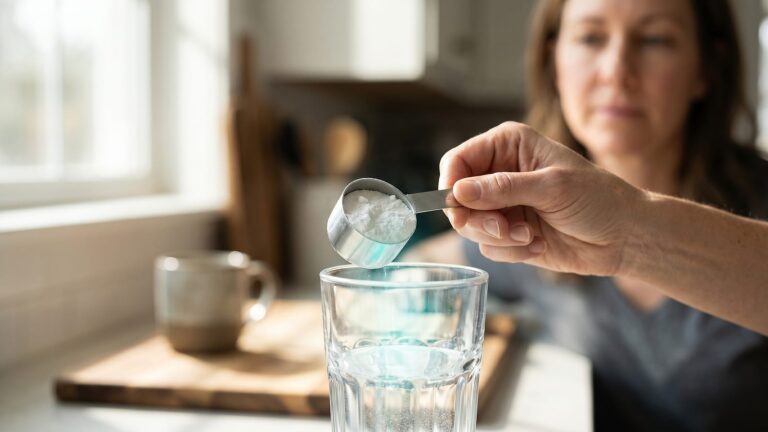
Glycine is cheap, found in food (it is rich in bone broth, gelatin, and meat), and well-tolerated in studies. The sleep evidence is encouraging but built on small trials [PMID: 37851316]. If you want to try it, the dose used in the sleep research was 3 grams about an hour before bed [PMID: 22529837].
Check with a doctor first if you take clozapine (glycine can interfere with it) or have kidney or liver disease. And glycine will not fix sleep that is wrecked by late caffeine, a bright phone, or a noisy room — fix those first. Glycine is a small add-on, not a rescue.
Verified Sources
- The effects of glycine on subjective daytime performance in partially sleep-restricted healthy volunteers. — Frontiers in neurology, 2012 (PMID 22529837)
- The effect of glycine administration on the characteristics of physiological systems in human adults: A systematic review. — GeroScience, 2024 (PMID 37851316)
- The sleep-promoting and hypothermic effects of glycine are mediated by NMDA receptors in the suprachiasmatic nucleus. — Neuropsychopharmacology, 2015 (PMID 25533534)
- L-Glycine: a novel antiinflammatory, immunomodulatory, and cytoprotective agent. — Current opinion in clinical nutrition and metabolic care, 2003 (PMID 12589194)
- Assessing the causal association of glycine with risk of cardio-metabolic diseases. — Nature communications, 2019 (PMID 30837465)
Crashing every afternoon? Tired but wired?
Get The 3 PM Crash Killer free — a science-backed guide to steady, all-day energy without more caffeine. Drop your email and we’ll send it straight to your inbox.
No spam. Unsubscribe anytime. Educational content, not medical advice.
professional before changing your diet, supplements, or treatment. These statements have not been
evaluated by the Food and Drug Administration and are not intended to diagnose, treat, cure, or prevent any disease.